Hello and welcome to another edition of Free Agent! Jason has been placed on the PUP (physically unable to publish) list this week, so I’ve been called up for a spot start.
Real football doesn’t start for another week (and “week zero” of college football is mostly nonsense), which means this is still baseball season, baby. Watching America’s pastime has actually never been more affordable, despite those $15 beers at Nationals Park. Sharpen your pencils and grab your scorebooks.
As I said, real football starts next week—and you can join the fun by signing up for the one and only official Reason survivor pool. Don’t be lame, do it.
Locker Room Links
- Federal prosecutors have accused Daejon Labrayae Love of posing as a fake player for the San Francisco 49ers as part of a scam that defrauded more than two dozen women out of more than $1.3 million. Love allegedly “had romantic relationships with many of the victims and told them he wanted to build wealth and a future together,” before asking them to take out personal loans to invest in “nonexistent investment vehicles.” Getting deeply invested in a scenario that ultimately fails to reward you? Every 49ers fan under 35 can relate.
- Novak Djokovic was upset in the first round of the U.S. Open by Mariano Navone in a match that lasted more than four and a half hours and included at least one puke break for the 24-time major champion, who said afterward that “I didn’t enjoy myself.” Checks out.
- End of an era: Lionel Messi says he is retiring from international soccer. Messi was the first player to score 20 career World Cup goals (though France’s Kylian Mbappe has already surpassed his scoring mark). See them all here.
- The end of a different era: ESPN is phasing out its “BottomLine” score and stat ticker—probably because we’re all already checking the scores and stats on our phones.
- A bunch of kids from Curaçao, a nation of about 150,000 people, won the Little League World Series for the second time.
- Folarin Balogun, the breakout star of America’s World Cup run this summer, will be playing in the English Premier League this season. Everton purchased Balogun’s contract from Monaco for a reported 40 million pounds (about $54 million).
- Elsewhere in Reason, Nick Gillespie explains how the 2006 film Idiocracy predicted the future—and maybe offers some hope too?
- Did you have a bad week? Buck up, at least you didn’t commit an error in six consecutive games like New York Yankees shortstop George Lombard Jr. (Adding injury to insult, Lombard also tweaked his knee and could miss a few games, although maybe that’s for the best.)
This hasn’t happened to a Yankees player in more than a century
George Lombard Jr. has committed an error in 6 straight games, the longest streak by a Yankee since Chick Fewster in 1921. pic.twitter.com/S58qmwsZLE
— ESPN Insights (@ESPNInsights) August 28, 2026

More Baseball for Fewer Bucks
It’s popular to complain about how much more expensive life has gotten—and I get it, high inflation sucks. But while it is easy to notice when prices increase or when the quality of goods and services erodes, it is often more difficult to quantify the abundance of modern life relative to the recent past.
Sports fans are probably more aware of those changes than a lot of other people. Many of us remember the dark days when the Red Zone channel didn’t exist and when not every NCAA Tournament game was on TV. Still, quantifying this stuff can be pretty staggering.
A few years ago, the economist Gale Pooley offered this comparison on his Substack: “A ticket to a Yankees game in 1923 cost $1.10. Unskilled workers back then were earning 22 cents an hour so it took them five hours of work to earn the money to buy a ticket. Blue-collar workers were earning 44 cents an hour so it only took them 2.5 hours.”
Of course, in 1923 there was no other way to watch the Yankees except at the ballpark. Today, the average wage in the U.S. is about $37 per hour, and a full season subscription to MLB.TV costs $149.99. That means that less than five hours of work can buy you a virtual ticket to every Major League Baseball game played this season (minus the blackouts and in-market games).
Or, as Pooley put it: “Enjoying baseball has become 242,000 percent more abundant.”
Yes, there are diminishing returns to getting 2,400 baseball games on your television. But this is a service that the richest person on the planet in 1920 (or 1950 or 1980) could not have bought at any price, and you can get it for less than a full day’s work. Inflation is bad, and politicians should stop pursuing policies that worsen it. Still, the best way to see how astonishingly wealthy modern America is is to notice the remarkable things we take for granted.
Playoffs Are for Winners
There are just four weeks left in the MLB season—and your team is probably still in the race, at least if it resides in the American League. Aside from Tampa Bay, Boston, and New York, the rest of the league is so mediocre that a team with a losing record might make the playoffs for the first time in baseball history. This happens routinely in the NBA and occasionally in the NFL, but it feels particularly gross in baseball because the 162-game regular season is supposed to be more meaningful and, historically, making the playoffs was more difficult than in other sports. Should baseball change its rules to prevent this from happening (in the future, no changes can be made this year)? ESPN’s Bradford Doolittle has some ideas, and the first one is pretty good: Simply don’t allow it.
“You have just five teams reach the .500 mark in a league? Fine,” he writes. “You get five playoff spots. The team that otherwise would have played a seed held by a losing team advances to the next round.”
Yes, this would obviously mess up the TV contracts by potentially reducing the number of playoff series. But I’d be even more radical about this idea. Make the cutoff something like “12 games behind the team with the best record.” So if the best team in your league wins 97 games, every other team needs 85 wins to qualify. Then draw up a bracket based on however many teams clear the bar.
Added bonus: that means the team on top can knock out potential playoff teams by winning otherwise meaningless games in the season’s final weeks—each win raises the bar for the stragglers. If you can’t stay within 12 games over the course of 162, sorry, you don’t deserve a crack at the championship.
That’ll never happen, but it should. (Tweet me your own crazy suggestions.)
A related point: There is going to be major offseason drama in MLB as the players and owners negotiate a new collective bargaining agreement. The widespread assumption is that the owners will try to implement a salary cap (in one form or another) to limit how much big market teams like the Los Angeles Dodgers and New York Mets can spend. But doesn’t the extreme parity in the American League suggest that the playing field is already pretty level under the current system?
Swing and a Miss
It looks like the Tampa Bay Rays will finally get their long-sought-after new ballpark, as the Hillsborough County Commission gave its final stamp of approval to a subsidy plan that will see the public kicking in about $2 billion in tax breaks and other goodies.
But here’s the real insult to the taxpaying public of the greater Tampa area. Just moments after voting for the subsidy package, Commissioner Chris Boles explained that his decision was motivated by The Giving Tree—otherwise known as the worst children’s book ever written—and then went on to admit that he completely misunderstands his own metaphor.
“You have a seed, and you let it grow, and it gives back over time, and it does all these things,” Boles said. “And in a way, this park is like the Giving Tree.”
As Neil deMause notes at his Field of Schemes blog, that is not at all how The Giving Tree goes: “The boy protagonist doesn’t plant the seed that turns into the tree, he just shows up, finds the tree in the first, eats its apples, climbs its trunk, ultimately cuts it down, and then as an old man sits on its stump.”
In this case, I’m afraid the taxpayers of Hillsborough County are the metaphorical tree.
The Next Indiana
OK, we can’t make the whole newsletter about baseball.
In the era of transfer windows and Name, Image, and Likeness money, which school has the best shot at duplicating Indiana’s incredible turnaround from Big 10 doormat to national champions? How about Thomas Jefferson’s very own University of Virginia
Virginia smoked N.C. State, 34–6, in one of the marquee-ish games of the opening week of the college football season, and The Athletic‘s Ralph D. Russo tabs them as a possible Cinderella story this season. “A straight line can be drawn from Indiana to Virginia when it comes to roster-building strategy. It’s all about experience, production and fit when coach Tony Elliott’s program dips into the portal,” he writes. Or maybe another basketball blueblood, Kentucky, can also make the leap to football powerhouse?
Such underdog runs are amazing because they are so rare, so don’t get your hopes up. For what it’s worth, ESPN’s college football simulations give Virginia a 1.7 percent chance of winning it all. Kentucky, meanwhile, has only a 1 percent chance of topping the SEC. Dare to dream, kids!
Replay of the Week
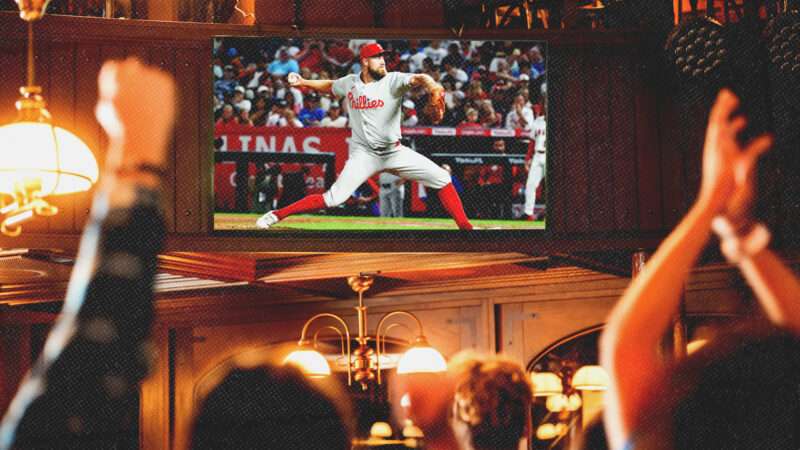
As a Phillies fan, I am admittedly a little biased here—but their 9th inning in Anaheim on Friday night included a game-saving home run robbery followed by a game-winning grand slam. Have you EVER seen that before?!
All the swings of emotion during an outrageous top of the 9th in Anaheim
pic.twitter.com/S71Dd50G7t
— MLB (@MLB) August 29, 2026
That’s all for this week. Enjoy watching the real games of the weekend: The Minnesota state amateur baseball championships, which continue through Labor Day.
The post 2,400 Baseball Games for the Price of 1 appeared first on Reason.com.
]]>
Hello and welcome to another edition of Free Agent! Be careful where you jump a fence this week, or you might face federal charges.
So a country with a bad government is in the World Cup. Should you root for them, stay away, or maybe it’s not that simple? We’ll dive into the situation with Iran’s men’s soccer team, then move on to what might be the worst new thing about this World Cup (not hydration breaks, sorry!), and close with five thoughts about golf’s U.S. Open.
Locker Room Links
- Congratulations to Giannis Antetokounmpo on going from Wisconsin’s 7.65 percent income tax rate (10th-worst in the nation!) to Florida’s 0.0 percent. This is going to save him at least $4 million a year.
- The PGA Tour has announced a major shake-up to its schedule and format.
- The caddies at Pebble Beach voted to unionize—possibly because their employer moved them from contractor status to full-time employees. “It is believed that this is the first time that elite caddies at a major golf destination have voted to unionize.”
- After (wisely!) rejecting a big subsidy for the Chicago Bears, Mayor Brandon Johnson wants to spend a $425 million subsidy on infrastructure for the Chicago Fire’s stadium.
- NASCAR’s race weekend on Naval Base Coronado in San Diego involved “no federal spending,” according to documents seen by The Athletic thanks to a FOIA request. The Navy got to keep all the money from alcohol sales.
- The MLB proposed a draft overhaul that would raise the age floor (two years past high school graduation for American players), shorten the draft, create a separate international draft, and make picks tradeable. The players union was not happy about it. College baseball fans should be! For better or for worse, I also think a higher age floor will make the draft a more effective way to rebuild.
- The Protect College Sports Act, which I covered before here, passed a Senate committee vote and could get a full Senate vote soon. The bill now restricts the Big 12 and ACC from conference expansion (the bill originally intended this only for the Big 10 and SEC). It also tries to close a loophole that may have unintentionally allowed for a super league. The NFL and NBA players unions, and the NFL itself, support the bill. The SEC and Big 10 are still opposed. Sen. Tommy Tuberville (R–Auburn), a former college football coach, suddenly withdrew his support.
- Elsewhere in Reason, the sports takeover continues. On the Giants Pride Night controversy, we have “Major League Baseball Teams Have the Right To Offer Pride Uniforms. Should They?” by Billy Binion (update here). On the World Cup, we have “England Fans Warned Not To Chant ‘Keir Starmer’s a Wanker’ at World Cup,” by our favorite English/Moroccan/Egyptian staffer, Reem Ibrahim.
- This is why no one outside of New York was rooting for the Knicks.
The Knicks overcame the odds and won the NBA championship.
We can also overcome the odds, beat the oligarchs and create an economy that works for all, not just the few. https://t.co/BrIly7rb9r
— Bernie Sanders (@BernieSanders) June 18, 2026
The Case for Rooting for Iran
If you love freedom, you wouldn’t root for the North Korean soccer team to win the World Cup, would you? (Perhaps you’d root for them to at least qualify, so a few players could courageously defect.) You wouldn’t root for the Soviet Union to win at Lake Placid in 1980. You’d probably never root for China, even if they paid you millions of dollars to do it.
So why should you root for Iran to succeed in a World Cup on U.S. soil?
It’s a nasty regime, after all. Dissent is brutally and murderously repressed. Rights are hard to come by. Even simple daily freedoms—like, say, going to a soccer match as a woman—are heavily restricted. The regime and sports in Iran are deeply intertwined. “In the Islamic Republic, sports are too serious to be left to the athletes,” as Kambiz Foroohar wrote for the Middle East Institute in 2021. “Over the past two decades, most sports clubs and related bodies have been taken over by political or security-military organizations, with former Revolutionary Guards holding the top positions.”
In theory, Iranian victories at the World Cup are a vindication of the regime. But somehow they have an opposite effect: Major victories by the men’s soccer team have often been the spark of anti-regime demonstrations.
When the men’s team qualified for the 1998 World Cup, thousands of young women went to the main stadium in Tehran to celebrate, even though the media called on them to stay home. Soon after, Iran won a World Cup match for the first time—against the United States. The New York Times‘ report on the celebrations mentions some anti-American sentiment, but plenty of exuberance that surely went beyond what the religiously conservative regime would have appreciated: “The young woman flung her head scarf off and hung out the window of the blue Volkswagen, her long red hair flying wild in the wind….A man and a woman sat halfway out of their car windows and swayed to the American rock music that blared from their car.”
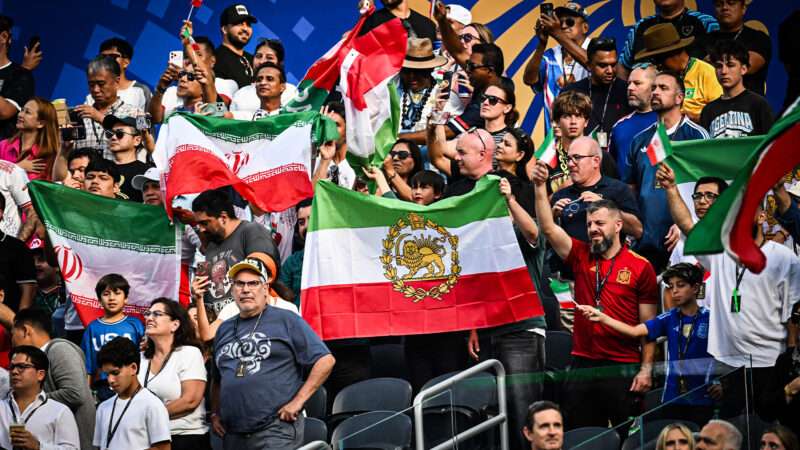
This “support the team, not the regime” sentiment was on full display at Iran’s first World Cup match on June 15, against New Zealand. The stadium in Los Angeles was overwhelmingly full of local Iranian supporters—who booed the regime’s national anthem, snuck the prerevolutionary Iranian flag past security, and steadfastly supported the team that technically represents the regime anyway (because of travel restrictions, it’s not like current Iranian residents were making the trip). The match was an exciting 2–2 draw.
My friend, the freelance journalist Natalie Fertig, was at the match and said the Iranian fans largely separated their support for the team from their negative view of the Iranian regime. She saw several flags that even blended together the American stars and stripes with the prerevolutionary Iran flag, and one “Make Iran Great Again” hat. The non-Iranians in attendance, whether American or European, generally seemed supportive of the Iranian team too. (A scuffle broke out in her section toward the end of the game over a flag, though it was unclear to her which flag and who felt aggrieved by it.)
Overall, she described a family atmosphere. Iranian-Americans brought their kids, greeted each other, and were proud to support the soccer team representing the country of their heritage, even if they don’t support those in government power (something even some Americans need to learn). “A lot of people want an excuse to love their country, even if they don’t agree with everything that its government does,” Natalie tells me. “That was really the sense that I got from the Iranian fans that I was around, was that they were so excited for this moment to support their identity and their culture, even if they were going to take the moment during the anthem to show opposition to the current government.”
So even if Iran makes it out of their group, or even wins a knockout game or two, don’t expect it to be used by the regime to tighten their tenuous stranglehold on the country. Iranians, at home and abroad, don’t seem to view the team as an extension of their government. The World Cup is a place for the team and their global fans to represent Iran (much like regular Americans should be the “face of America,” not whoever is president).
“That’s the World Cup, right? It’s people finding ways to separate what governments do from who people are,” Natalie says. “And that oftentimes, people no matter where they live, want the same things out of life.”
As it turns out, people can have nuanced opinions on the Iran regime, the Iran soccer team, and the Iran war all at the same time. Maybe America’s geopolitical enemies don’t always have to be our sporting enemies, too.
The Worst Rule at the World Cup?
It’s great that FIFA is trying to crack down on racist abuse against players, whether it’s coming from the stands or from the other team. But this rule is giving me major “if you’re not doing anything wrong, you have nothing to worry about!” vibes.
HISTORIC SENDING-OFF
Paraguay's Miguel Almirón becomes the first player at the 2026 World Cup given a red card under the new rules barring players from covering their mouths to conceal discriminatory behavior. pic.twitter.com/mE4PnzZ3oe
— Men in Blazers (@MenInBlazers) June 20, 2026

The theory, I guess, is that if players are about to say something racist or insulting, they’ll cover their mouths so that the lipreaders in the peanut gallery can’t turn them in. But banning mouth-covering is a bit like banning guns or banning VPNs—it assumes there are no legitimate uses and anyone who wants to use this or do that must have nefarious reasons for it.
But in the sporting context, as any (American) football coach can tell you, there are very important reasons to cover your mouth when speaking in the middle of a game. The rule does specify that it’s supposed to involve “a confrontational situation with an opponent,” but it still seems likely that an overzealous referee might punish a player for an innocent action or inoffensive language.
If someone facepalms or wipes their face while talking to an opponent, is that deserving of a red? We’ll find out!
Especially since covering your mouth doesn’t affect gameplay, the punishment being a straight red card (thus kicking the player out of the game and his team can’t replace him) instead of a yellow card seems harsh. If a player says something racist, give them a red card—but don’t kick them out for something that maybe, you’re not sure, could have been done to conceal saying something racist.
That said, I’m sorry that I can’t get worked up about the hydration breaks that soccer purists are mad about. Maybe I’m just used to commercial breaks as an American, or used to seeing Arsenal use an injury break to take a drink and get some coaching. The breaks seem to change up momentum a little bit, and I’m fine with that. If you were FOX, you’d gladly use them to make $250 million (or more) too.
The Worst Golfer, Par None
Since I invested a lot of time and energy into consuming U.S. Open content this week, here are some quick thoughts:
- I really do not like Wyndham Clark. There are a lot of golfers I like, there are some I’m ambivalent about, and some I don’t care for. I don’t think I hate any of them, but Clark comes close. Even the LIV Golf defectors have (mostly) only given me one reason to not like them, and I at least understand why they defected. Clark has given me several reasons to not like him.
- Thankfully, sports are better when there’s a villain to root against, and golf is desperately in need of one as the power of the LIV Golf defectors fades away.
- I’d still rather live in the universe where this putt on the 18th hole drops and we get to see a playoff instead. Putting is based more on randomness and luck than you’d think!
- The U.S. Open is run by the United States Golf Association, who governs golf for pretty much everyone in the country who isn’t a professional player—your weekend hackers, your regular Joes, and even your played-in-college-but-not-Tour-material players. (It does decide rules of play and equipment standards for professionals, too). As such, I think they should only have the U.S. Open at public courses that everyone has access to (everyone who can afford them, anyway). They don’t have to be municipal courses (like Bethpage), but this would still include many iconic courses like Pebble Beach, Pinehurst, Torrey Pines, etc. Leave the fancy, exclusive country club courses for the PGA Championship. The point of the U.S. Open’s site selection should be “You could play here too!”
- I’m not related to Miles Russell, but I’d like to be. This is awesome stuff.

Miles Russell's father, Joe, took over as caddie for his son's final walk up 18.
What a Father's Day gift! pic.twitter.com/7tfHKSrjyx
— U.S. Open (@usopengolf) June 21, 2026
Replay of the Week
The best soccer teams always know how to utilize the sport’s most secret weapon: the own goal.
1-0! GOOOOAL FOR USA!
Flo Balogun charges in and the @USMNT finds the back of the net on the own goal pic.twitter.com/GdivDaeNt9
— FOX Sports (@FOXSports) June 19, 2026

That’s all for this week. Enjoy watching the real event of the weekend, pickleball’s 2026 APP Vlasic Classic Cincinnati (we need more pickle sponsorships in sports).
The post You Can Root for Iran at the World Cup Without Rooting for the Iranian Regime appeared first on Reason.com.
]]>
This week, President Donald Trump advocated on behalf of asylum seekers—though only in one very specific situation.
Before an Asian Cup match in Australia, Iran’s women’s soccer team declined to sing their country’s national anthem, though they “sang the anthem and saluted in later matches,” according to Bloomberg.
Supporters of the Iranian regime called for reprisal. “This is the pinnacle of dishonour and lack of patriotism,” said Mohammad Reza Shahbazi, a presenter on Iranian state TV, according to The Athletic. “Both the people and the officials should treat these individuals as wartime traitors, not as if they just had a protest or performed a symbolic act. The stigma of dishonour and betrayal must remain on their foreheads, and separately they must be dealt with properly.”
The New York Post reported that after playing their final match and facing a return trip home, some of the players “appeared to flash a ‘help’ hand signal” to the press.
Thankfully, their story so far has a happy ending: CNN reported Monday that five members of the team “have sought asylum in Australia and and [sic] are currently safe with police.”
Perhaps the unlikeliest supporter of their cause: President Donald Trump.
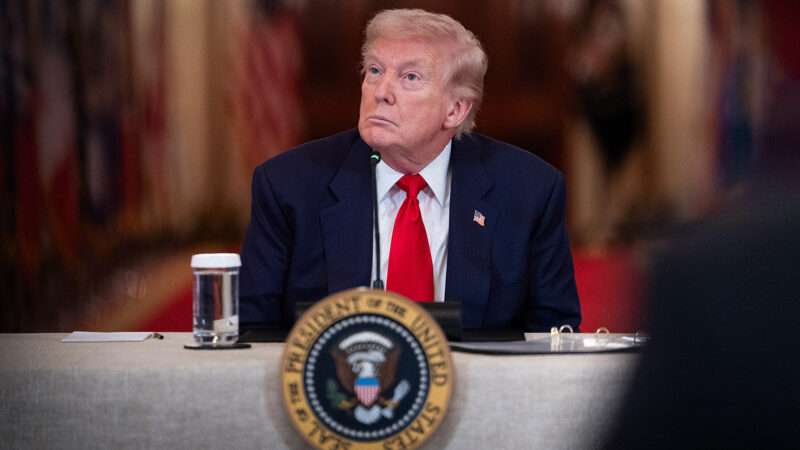
“Australia is making a terrible humanitarian mistake by allowing the Iran National Woman’s Soccer team to be forced back to Iran, where they will most likely be killed,” Trump wrote on Truth Social, in a post shared by the White House’s official X account, while the situation still seemed tenuous. “Don’t do it, Mr. Prime Minister, give ASYLUM. The U.S. will take them if you won’t.”
“Australia is making a terrible humanitarian mistake by allowing the Iran National Woman’s Soccer team to be forced back to Iran, where they will most likely be killed. Don’t do it, Mr. Prime Minister, give ASYLUM. The U.S. will take them if you won’t…” – @POTUS pic.twitter.com/OTIsmVavJR
— The White House (@WhiteHouse) March 9, 2026
“I just spoke to Prime Minister Anthony Albanese, of Australia, concerning the Iranian National Women’s Soccer Team. He’s on it!” Trump added in a post less than two hours later. “Five have already been taken care of, and the rest are on their way. Some, however, feel they must go back because they are worried about the safety of their families, including threats to those family members if they don’t return. In any event, the Prime Minister is doing a very good job having to do with this rather delicate situation. God bless Australia!”
Trump’s willingness to advocate on the players’ behalf is laudable—and completely at odds with his position on the subject in nearly every other scenario.
“In October 2025, the Trump administration slammed the door shut to the world’s most miserable, slashing the annual cap of refugee intake by 94 percent, to an all-time low of 7,500,” Matt Welch wrote in the current issue of Reason.
Asylum is a similar process, and Trump has been just as vocal in his condemnation—frequently invoking mental institutions and the fictional serial killer Hannibal Lecter to inveigh against those seeking asylum in the U.S. from other countries.
In recent months, the administration has dismissed asylum cases for applicants who applied between 2019 and 2022, and it paused all asylum decisions, effectively preventing any new asylees from entering the country. It is also now arresting refugees who have been in the country a year but don’t yet have a green card.
Incidentally, international sporting events have long been an occasion for defections from authoritarian nations—most visibly, the Olympics. “In 1956, shortly after the Soviets crushed the Hungarian revolution, nearly half of the Hungarian team’s 100-member delegation to the games in Melbourne defected,” David Hejmanowski wrote in 2024 for the Delaware Gazette. “Several members of the Afghanistan delegation defected during the 1980 Moscow games, and four Romanians failed to return home from Canada after the 1976 games in Montreal.”
Baseball also has a rich history of players defecting from more onerous regimes. “Hundreds of Cuban players have defected over the years, many choosing to play American Major or Minor League Baseball,” Reason‘s Alyssa Varas-Martinez wrote in 2023. And yet during his first term, Trump made this more difficult, overturning an agreement between baseball organizations in the two countries that would have made it easier for American teams to sign Cuban players.
Indeed, American presidents should routinely make the case for those suffering under repression around the world to make their way to our shores. “I had always hoped that this land might become a safe & agreeable Asylum to the virtuous & persecuted part of mankind, to whatever nation they might belong,” George Washington wrote in 1788.
Trump’s sudden advocacy on behalf of the Iran women’s soccer team is commendable. The only thing that could make it better is if he expanded that same magnanimity to asylum seekers from all across the world.
The post Trump Supports Asylum for Iranian Women's Soccer Team. His Immigration Policy Doesn't. appeared first on Reason.com.
]]>
Political activists already treat elections like team sports, fanatically rooting for Team Red or Team Blue regardless of ever-changing ideologies—so why not watch and bet on actual team sports instead?
The stakes are a lot lower in sports. No one gets deported if Michigan beats Ohio State three times in a row (fortunately for head coach Ryan Day). Inflation won’t rise if long-suffering carpetbagger Yankees fans ever get to celebrate another World Series title. Sports don’t really change public policy at all, since the Nashville Metropolitan Council has shown local governments are willing to shell out $1 billion for shiny new stadiums even for hapless teams like the Tennessee Titans.
But if the stakes in team sports are actually too low for you, you might as well put a $5 bet down on a random game to get yourself interested.
Moneyline bets on a game’s outright winner are my preference when betting—it’s good to have the team’s incentives aligned with mine, unlike over/under bets on combined score or player prop bets on individual performances. But layers upon layers of betting options are available if a straight-up bet doesn’t strike your fancy.
You could bet on James Madison University to score in every quarter of its next game. You could bet on Arsenal to score exactly one goal in the first half of their match against Inter Milan. You could bet on a Dylan Larkin hat trick. You could bet on Fremantle to “win the flag” in the Australian Football League (apparently that means to win the championship).
I am absolutely not saying any of those bets will be winners (especially Fremantle, who I picked just because they have a cool name). But winning money off the bets isn’t the point; it’s the enjoyment you get from watching and having a vested interest in the outcome of the bet—winning your money back plus a little extra is just a nice bonus. Wouldn’t it be fun to spend 2025 following Fremantle’s season? Would you do that if you didn’t have a $5 bet on them to win the flag? Wouldn’t your friends think it was cool that you got into a random Aussie rules football team? (OK, some might think it was weird.)
If you’re just betting a little money, a multileg parlay is a fun way to combine action on a few bets in hopes of scoring a bigger payday (but the house’s cut is bigger on parlays, so they’re not a good long-term strategy). Your $5 bet will be a lot more likely to go down the drain, but there’s a small chance for it to be multiplied many times over.
Thankfully, if you do prefer politics to sports, betting on the election is now legal in America—a federal appeals court ruled that the Commodity Futures Trading Commission failed to prove that election betting was a threat to election integrity. Platforms such as Polymarket and Kalshi offer bets on the Electoral College winner, popular vote winner, the margins of those votes, the balance of power in Congress, and much more, even outside of politics.
Maybe all this sounds like a crazy way to lose money that can only lead to financial ruin. Perhaps that’s true for the rare few who fall into gambling addiction, but even those people are mostly losing their own money. Politicians are addicted to losing billions of dollars of other people’s money every year, and far too few people ever bat an eye at it. Losing $5 on a dumb sports bet pales in comparison to $7.5 billion in government cash building just eight electric vehicle chargers in two and a half years.
Whose bet was worse, that or my $5 bet on Fremantle? (Go Dockers!)
The post To Get Through This Election, Bet on Sports appeared first on Reason.com.
]]>