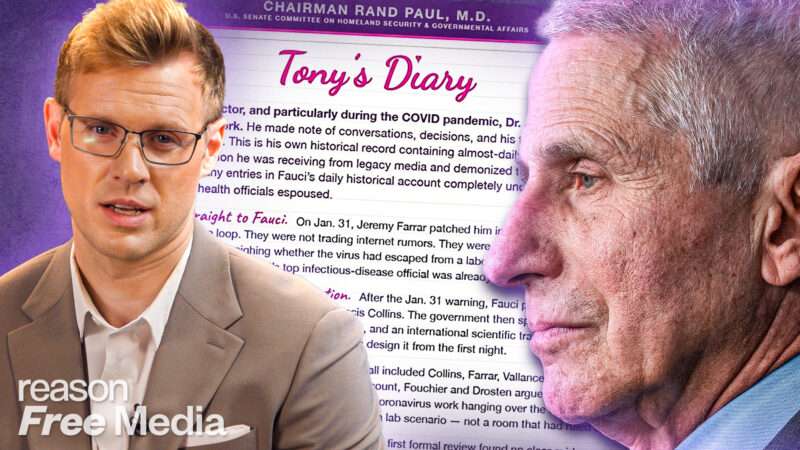
Sen. Rand Paul (R–Ky.) has released entries from the diary of Dr. Anthony Fauci, and you’ll never guess what the ex-coronavirus advisor actually wrote about the origins of COVID-19. Paul has revealed there’s a massive gap between what Fauci said in public and what he said in private about the likely start of the pandemic.
At the start of the pandemic, on January 26th, 2020, Fauci wrote that he did not think the Huanan Seafood Wholesale Market in Wuhan, China, was where COVID jumped from animals to humans. He wrote: “Now we know the market was not the source, it was the amplifier.” He cited other cases that he thought demonstrated COVID was circulating in the population in China prior to that.
So maybe Fauci changed his mind later? OK. But here’s where things get interesting. Just one week later, Fauci convened a call with a bunch of other virologists. There were 12 scientists on that call. According to Fauci’s diary, only two of the scientists were convinced that COVID had arisen naturally from animal spillover. The rest of them “felt that deliberate insertion was possible”—i.e., that the virus was engineered in a lab. That conclusion, however, was inconvenient for Fauci because he had served for decades as the foremost public advocate of gain-of-function research—of experimenting on coronaviruses so that they become more transmissible and more deadly.
After the call, several of those scientists got to work on a paper titled “The Proximal Origin of SARS-CoV-2“. Published in March 2020, it concluded that the evidence favored a natural origin. We already know that Fauci pushed the authors to reach a stronger conclusion than they were comfortable with. But now we also know that behind the scenes, Fauci was well aware of the scientists’ skepticism, and he himself had written that he also doubted the market as the spillover event.
Taken together, these details prove that these two Faucis—public Fauci and private Fauci—were totally at odds. And that’s just on COVID’s origins. The diary also reveals Fauci has a very inflated sense of his own self-importance. He’s thrilled about the level of influence he’s achieved, and he’s happy to opine on all sorts of subjects other than sticking to the science. For instance, in his diary, he says he told then-President Donald Trump to implement stricter mitigation measures because the public might punish him at the ballot box if he failed to do what Fauci advised. I guess the doctor decided he was an expert on diseases, public policy, political science, and campaigning.
In his diary, Fauci also states unequivocally that he told New York City Mayor Bill de Blasio to shut down bars, restaurants, and schools. That’s pretty interesting, because when journalist Batya Ungar-Sargon and I interviewed him in 2022, he denied ever having had the power to do that.
"First of all, I didn't recommend locking anything down."
– Fauci https://t.co/33H6vfIoBI pic.twitter.com/4eVoIPdmst
— Greg Price (@greg_price11) July 26, 2026
Maybe Dr. Fauci should have double-checked his own diary.
Now look, you might be thinking, does this really still matter? COVID-19 is in the rearview mirror, and Fauci is retired. Moreover, as much as these diary entries reveal him to be inconsistent at best and hypocritical at worst, it’s not a crime to have given the president bad advice. That’s all true. But it is a crime to lie to Congress, and there needs to be accountability for public funding of reckless research that maybe experts believe could have been responsible for the creation of the virus. Recall that Fauci has admitted under oath that he may have continued to sign off on gain-of-function research even during the time period that President Barack Obama had ordered it brought to a halt.
Curiously, President Joe Biden’s pardon of Fauci covers that exact time period—the Obama-era pause on gain-of-function research. Not Fauci’s entire career in public service, which goes back decades, and not just Fauci’s time as the Coronavirus advisor, but a 10-year period that includes the pause.
That’s very telling, and we should continue to search for answers, because even if we can’t bring Fauci to justice, we need to know the truth.
If you enjoy this kind of content and want more, subscribe to my newsletter, Free Media.
The post What Anthony Fauci's Diary Reveals About COVID appeared first on Reason.com.
]]>
A new report from the Council on Criminal Justice (CCJ) suggests the national homicide rate this year will hit a historic low, continuing a downward trend that began in 2022. In January, the CCJ estimated that the 2025 homicide rate would be the lowest since at least 1900, and the latest numbers indicate that the 2026 rate will be even lower. Other kinds of crime are also down, in some cases dramatically.
That development is surely welcome news. But we should be skeptical of the explanations offered by politicians of both major parties, who habitually reduce a complex reality to evidence in favor of the policies they have long supported.
The CCJ collects crime data from 36 U.S. cities, ranging in size from Rochester (population: 200,000) to New York City (8.5 million). The homicide estimates are based on data from 30 cities that have consistently reported numbers for that crime since 2018.
After rising slightly in 2019, the average homicide rate in the CCJ sample shot up in 2020, consistent with FBI data indicating a 30 percent increase that year. The rate in the CCJ sample rose again in 2021 and fell slightly in 2022 before dropping dramatically in 2023, 2024, and 2025. According to the new report, the average homicide rate for the first half of this year was down 18 percent from the same period in 2025 and down 51 percent since the first half of 2022.
This trend goes beyond a reversion to the pre-2020 norm. “Across the sample cities,” the CCJ says, “the 2026 average homicide rate” for January through June was “about 31% lower than in 2019.”
The FBI’s national numbers tell a similar story: Homicides fell by 11.6 percent in 2023, nearly 15 percent in 2024, and 18.1 percent in 2025 (based on a preliminary estimate). According to the FBI’s preliminary data, murders during the year ending in April 2026 were down 18.2 percent from the previous 12 months.
A longer view puts these numbers in perspective. Between 1991 and 2014, according to the CCJ’s national numbers, the homicide rate fell by more than 50 percent, then rose for a few years. But as of 2019, it was still about half the 1991 peak. The estimated rate for 2025, 4 per 100,000 residents, is even lower than the 2014 number (4.4), and it seems this year’s rate will be lower still.
Looking further back, the lowest homicide rate recorded since 1900, according to the CCJ’s graph, was 4.5 per 100,000, the rate in 1957 and 1958. Those numbers come from criminologist Randolph Roth’s 2009 book American Homicide. “These data rely primarily on death registration records,” the CCJ says, “and are widely regarded as the most reliable source for estimating homicide trends prior to the modern era of national crime reporting.”
A Bureau of Justice Statistics report lists somewhat lower rates for the 1950s, as low as 4.0 in 1957. But “when the FBI went back with a new methodology in 1958,” crime analyst Jeff Asher notes, “they looked at data from 1957 again and estimated that the actual 1957 murder rate was at 4.7 per 100,000.” In other words, it looks like the current homicide rate is even lower than the historic lows recorded during the 1950s.
The CCJ also reports large declines in three other crimes based on data for the first half of each year. The carjacking and car theft rates, both of which peaked in 2023, have since fallen by 73 percent and 51 percent, respectively. The residential burglary rate in the first half of 2026 was 56 percent lower than its 2018 peak.
Comparing the first half of 2026 to the first half of 2025, the CCJ reports declines in aggravated assault (2 percent), gun assault (6 percent), larceny (6 percent), nonresidential burglary (10 percent), residential burglary (13 percent), robbery (17 percent), car theft (20 percent), and carjacking (47 percent). By contrast, sexual assault, shoplifting, and domestic violence rose by 3 percent, 4 percent, and 8 percent, respectively.
Overall, violent crime from January through June was “at or below levels in the first half of 2019,” the CCJ says. Nonviolent crime also was “generally below levels seen in the first six months of 2019.”
President Donald Trump would like to take credit for these positive trends. “Last year, the murder rate saw its single largest decline in recorded history,” he bragged during his 2026 State of the Union address. “This is the biggest decline, think of it, in recorded history. The lowest number in over 125 years.”
Inconveniently for Trump, the 2020 murder surge happened on his watch, and the rate began falling before he started his second term. In any case, it is doubtful that presidential policies have much impact on crime rates. Although Trump credits immigration enforcement, for example, his deportation campaign, contrary to the way he portrays it, is by no means carefully targeted at unauthorized residents who pose a threat to public safety.
The evidence also casts doubt on policy prescriptions that Democrats tend to offer. “Private gun ownership in America has surged in the past several years,” the CCJ notes. “Meanwhile, violent crime, particularly homicide, saw a historic rise followed by a historic decline.”
The CCJ suggests a few more plausible theories, although none is completely satisfying. “A range of crime researchers and practitioners broadly agree that there’s no single explanation for the decline” in homicides, it says. “Instead, it reflects multiple forces moving in the same direction, from prevention efforts and law enforcement strategies to broader social changes following the pandemic shock.”
Last February in USA Today, CCJ President Adam Gelb cautioned against “partisan platitudes” that offer simplistic explanations for the ongoing crime drop. “Murder and other crime are falling in cities that are governed by different political philosophies, operating under varied policing and prosecution models and facing distinct local economic conditions,” he noted. “Local policies and programs surely matter. But the striking consistency of the crime decline across the country suggests that macro-level forces are exerting enormous influence as well.”
It is plausible that the 2020 homicide spike, like the concomitant surge in drug-related deaths, had something to do with the social, economic, and educational upheaval caused by the COVID-19 pandemic and the government’s response to it. “As schools, workplaces, social programs, churches and civic institutions regained footing after COVID-19 disruption,” Gelb noted, “emotional and economic stresses eased and daily routines strengthened.”
Gelb added that “courts slowed by COVID-19 disruptions have largely resumed normal function”; that “police departments, on their heels after the protests of 2020, have reemphasized targeted enforcement strategies”; and that “communities have scaled up violence prevention efforts and prisoner reentry programs to unprecedented levels, aided in part by federal recovery funds.” He conceded that “immigration enforcement has removed dangerous offenders” but added that it has swept up “many people who pose little or no public safety risk.”
Gelb also credited “the spread of public and private surveillance cameras and license plate readers,” which he said had “deterred would-be offenders while helping police solve more cases.” He added that “the transition to digital transactions means fewer people carry cash, making them less attractive targets of a robbery.” And he suggested that “the gravitational pull of cyberspace” may be “altering social routines historically associated with street violence.”
Gelb mentioned several other possible factors, including changes in illicit drug markets, reduced alcohol consumption, less exposure to “environmental toxins” such as lead, and the “grim demographic reality” that homicides and drug overdoses may have “removed tens of thousands of high-risk people from the population.” But he noted that “researchers are still struggling to confidently explain the long-term crime drop that began in the early 1990s,” which suggests that “definitive answers about current trends will take time.”
The honest answer to the question of why crime is falling, in short, is that we don’t really know and may never be sure. As tempting as it may be for politicians, it is not safe to assume that any particular government policies have played an important role in the absence of evidence that they actually work.
The post The Homicide Rate Has Dropped to Historic Lows. Contrary to What Politicians Say, No One Really Knows Why. appeared first on Reason.com.
]]>
The former head of the Trump administration’s investigation into COVID-19’s origins told Congress today that the CIA actively frustrated his work by withholding records, retaliating against agency personnel who cooperated with the investigation, and surveilling investigators’ computer and phone usage and contact with whistleblowers.
“These were Americans being spied upon illegally while executing duties directed by the president and under the director of National Intelligence,” James Erdman III, a current CIA officer who led the Office of the Director of National Intelligence (ODNI) investigation into COVID’s origins, told the Senate’s Homeland Security Committee today.
Additionally, Erdman claimed that the CIA had suppressed its own analysts’ assessment that COVID came from a lab leak and retaliated against them when they stuck to this conclusion.
In January 2025, the CIA, now helmed by new Trump-appointed director John Ratcliffe, said publicly that it now assessed a lab leak as the most likely origin point for COVID. Previously, the agency had been noncommittal.
Under the Biden administration, ODNI released two unclassified summaries of the intelligence community’s assessment of the pandemic’s origins. Both stated that four agencies assessed a natural origin of COVID as most likely, while another one assessed that a lab leak was a more likely cause of the pandemic. Three agencies couldn’t say whether a lab leak or natural origin was more likely.
In his testimony today, Erdman said that the wider intelligence community’s initial reluctance to land on a lab leak conclusion was the product of the influence of former COVID-19 adviser Anthony Fauci, who curated lists of scientists for agencies to consult.
These scientists, said Erdman, specialized in the kind of gain-of-function research that plausibly led to the creation of COVID at the Wuhan Institute of Virology and were therefore not neutral observers.
In 2023, Congress unanimously passed legislation requiring ODNI to release the intelligence community’s findings on the origins of COVID. In response to that law, the Biden administration released a 9-page, partially redacted summary of already released intelligence.
Erdman said in his testimony today that under its new director, Tulsi Gabbard, ODNI is in the process of declassifying some 2,000 documents related to COVID’s origins, but that this work has been slowed by the CIA and State Department refusing to turn over requested documents.
He also said that the CIA fired a contractor one day after he spoke with ODNI investigators.
“The deep state still resists this congressional mandate” to release documents on COVID’s origins, said Sen. Rand Paul (R–Ky.), who chairs the Homeland Security committee, at today’s hearing.
Paul has long argued that a lab leak origin of COVID is probable. He’s introduced legislation that would subject gain-of-function research proposals to more rigorous risk-benefit vetting by an independent panel.
The Trump administration also issued an executive order last year that called for a policy effectively banning gain-of-function research to be released by September 2025. No such policy has been published yet.
At the hearing today, Erdman said that resistance to oversight by both intelligence agencies and the public health officials was preventing the administration from implementing new restrictions on gain-of-function research.
The post Whistleblower Tells Congress the CIA Illegally Spied on White House Officials Investigating COVID Origins appeared first on Reason.com.
]]>
Since being sworn in as Health and Human Services (HHS) secretary, Robert F. Kennedy Jr has repeatedly tried to undermine public trust in vaccines. His agency recently took steps to slow down the development of these public health tools yet again.
This week, vaccine manufacturer Moderna revealed that Vinaya Prasad, the top vaccine regulator at the Food and Drug Administration (FDA)—which is a part of HHS—declined to even consider the safety and efficacy of the company’s new mRNA influenza vaccine.
The decision is not surprising, especially when one considers Kennedy’s past statements on mRNA vaccines. Nor is it surprising, given the broad discretion that the FDA has on public health. The FDA’s precautionary approach to all matters has slowed innovation in a variety of areas. In August 2025, the agency limited access to COVID-19 vaccinations (chiefly mRNA vaccines) to people aged 65 and older and to those with underlying health conditions that put them at higher risk of severe outcomes.
In his letter, Prasad claimed that the agency would not consider the merits of Moderna’s mRNA-1010 vaccine because, in its clinical trials, the company allegedly did not compare the efficacy of its vaccine with “the best-available standard of care in the United States at the time of the study.” The company actually had compared its vaccine to both a standard-dose vaccine and a high-dose vaccine, which is often recommended for people over age 65. That safety and immunogenicity study reported in March 2025 that the “findings from this phase 3 study demonstrate that mRNA-1010 elicited superior immune responses relative to licensed standard- or high-dose seasonal influenza vaccines in adults of all ages and raised no new safety concerns.”
In June of last year, Moderna reported the results of a clinical trial pitting its mRNA influenza vaccine against both high-dose and standard-dose licensed seasonal influenza vaccines. The conventional vaccines used inactivated flu viruses to induce an immune response. In the trial, the group that used Moderna’s mRNA-1010 had 26.6 percent fewer influenza cases than the group that got the standard-dose flu shot. This means that if the standard flu vaccine group had 100 cases per 1,000 people, the mRNA-1010 group would have had about 73–74 cases per 1,000. With respect to the risks of hospitalization, this level of protection is pretty comparable to conventional high-dose vaccines.
A January article in the journal npj Vaccines reported that Moderna’s mRNA flu vaccine did as well or better at inducing immune responses against flu viruses as conventional high-dose vaccines do now. The authors concluded that “mRNA-based vaccines are a promising alternative to currently licensed influenza vaccines, with the additional advantages of the mRNA technology that can incorporate rapid strain updates and a flexible manufacturing platform that could enable the production and distribution of regionally matched influenza vaccines for improved effectiveness.” In other words, mRNA flu vaccines work just as well as the most effective conventional vaccines but can be modified and manufactured more quickly to address ever-changing viruses.
In response to Prasad’s letter, The Washington Post editorial board declared, “Overzealous government agencies arbitrarily suppressing innovation is lamentable. When that innovation could save countless lives, it becomes a tragedy.”
That’s evidently a tragedy that Kennedy and his subordinates are more than willing to abet.
The post Clinical Trials Show Moderna's New mRNA Flu Vaccine Is Safe and Effective. FDA Won't Even Consider It. appeared first on Reason.com.
]]>
Defending COVID-19 policies against legal challenges, government officials relied heavily on Jacobson v. Massachusetts, a 1905 case in which the U.S. Supreme Court upheld a smallpox vaccine mandate imposed by the Cambridge Board of Health. But the breadth of the license granted by that decision is a matter of dispute, even as applied to superficially similar COVID-19 vaccination requirements.
Critics of those mandates argued that COVID-19 shots, unlike smallpox vaccination, do not prevent disease transmission, so requiring them amounts to paternalistic intervention rather than protection of the general public. Last summer in Health Freedom Fund v. Carvalho, the U.S. Court of Appeals for the 9th Circuit dismissed that distinction as constitutionally irrelevant.
Rejecting a challenge to a 2021 COVID-19 vaccine mandate that the Los Angeles Unified School District (LAUSD) imposed on its employees, the majority held that the district “could have reasonably concluded that COVID-19 vaccines would protect the health and safety of its employees and students.” The implications of the 9th Circuit’s decision for the right to bodily integrity are alarmingly broad, since the court’s logic would seem to bless all manner of medical mandates that the government views as beneficial to the patient, even if they have no effect on other people.
The plaintiffs in the 9th Circuit case, including LAUSD employees who were fired because they refused to comply with the vaccine requirement, argued that Jacobson did not authorize that policy. Their case featured dueling interpretations of Jacobson that reflected different understandings of “public health.”
Is that rationale for government action limited to external threats such as disease carriers and air pollution, where someone’s actions risk harming others, or does it extend to self-regarding decisions that do not impinge on other people’s rights, such as lifestyle choices and consent to medical treatment? The 9th Circuit’s ruling implicitly embraces the latter view, which invites far-ranging, open-ended interference with individual freedom.
In Jacobson, the Supreme Court weighed “the inherent right of every freeman to care for his own body and health in such way as to him seems best” against the government’s interest in “preventing the spread of smallpox.” The majority repeatedly referred to that danger and noted “the common belief,” supported by “high medical authority,” that vaccination was effective at addressing it. The Court rejected the premise that people may do as they like “regardless of the injury that may be done to others.”
That concern about injury to others, the plaintiffs in the 9th Circuit case argued, did not apply in the context of COVID-19 vaccine mandates. While smallpox vaccination effectively curtailed the spread of disease, they said, COVID-19 vaccines do not prevent infection or transmission, although they may reduce symptom severity in people who receive them.
The LAUSD argued that COVID-19 vaccination does make transmission less likely, or at least that it was reasonable to think so when the mandate was adopted. But initial expectations, based on clinical trials, that the vaccines would effectively retard the spread of COVID-19 were contradicted by real-world experience, especially with emerging variants of the virus.
In 2024, a three-judge 9th Circuit panel deemed that point relevant. The majority noted that Jacobson “did not involve a claim in which the compelled vaccine was ‘designed to reduce symptoms in the infected vaccine recipient rather than to prevent transmission and infection.'”
When an 11-judge panel reheard the case, however, the majority concluded that the LAUSD mandate’s constitutionality depended on “what reasonable legislative and executive decisionmakers could have rationally concluded about whether a vaccine protects the public’s health and safety, not whether a vaccine actually provides immunity to or prevents transmission of a disease.” Since the plaintiffs conceded that COVID-19 vaccines “lessen the severity of symptoms for individuals who receive them,” the court said, the policy easily passed muster.
The majority “suggests that Jacobson‘s reference to ‘public health and public safety’ is so capacious that merely ‘lessen[ing] the severity of symptoms’ is enough to justify a vaccine mandate,” two dissenting judges complained. That logic, they warned, “comes perilously close to giving the government carte blanche to require a vaccine or even medical treatment against people’s will so long as it asserts—even if incorrectly—that it would promote ‘public health and safety.'”
The implications of the 9th Circuit’s decision extend beyond coercive medical treatment. The court’s expansive understanding of “public health and safety” obliterates the distinction between public and private, justifying forcible intervention whenever the government thinks it will protect recalcitrant individuals from disease or injury.
The post Can the Government Mandate a Vaccine for Your Own Good? This Federal Court Says Yes. appeared first on Reason.com.
]]>While Alphabet “continued to develop and enforce its policies independently, Biden Administration officials continued to press [Alphabet] to remove non-violative user-generated content,” a lawyer for Alphabet wrote in a September 23 letter to House Judiciary Committee Chairman Jim Jordan. Administration officials including Biden “created a political atmosphere that sought to influence the actions” of private tech platforms regarding the moderation of misinformation.
The company will now restore the accounts of certain content creators removed as part of efforts to tamp down on misinformation related to COVID-19 or the 2020 presidential election. “YouTube will prove an opportunity for all creators to rejoin the platform if the Company terminated their channels for repeated violations of COVID-19 and elections integrity policies that are no longer in effect,” the letter said.
These announcements came in response to Judiciary Committee subpoenas sent as part of the committee’s investigation into government efforts to “weaponize” tech companies to suppressing disfavored speech.
Jordan has been crowing about both Alphabet’s admissions and its pledge to reinstate creators whom he described on X as being “censored for political speech” on YouTube. “This is another victory in the fight against censorship,” Jordan posted.
I agree. Some have defended the Biden administration’s pressure on social media companies, saying that since it only amounted to suggestions and requests—not demands—and that it was fair game. But when those suggestions and requests come amid a bevy of bills aimed at big tech companies, a slew of congressional hearings where lawmakers excoriated big tech, pledges by the administration to use antitrust laws to break up big tech companies (and follow through there from both the Department of Justice and the Federal Trade Commission), and condemnation from the highest levels of government—including the president—it’s hard to take seriously the idea that this was just friendly and harmless repertoire. At the very least, it’s easy to imagine how tech companies might have taken the Biden administration’s comments as more than mere requests.
This is what has come to be known as “jawboning,” and the fact that it doesn’t involve direct censorship may make it even more insidious. Direct censorship can be challenged in court. This sort of wink-and-nod regulation of speech leaves companies and their users with little recourse.
All of that being said, the Biden administration’s attempts to pressure private companies into doing their bidding with regard to free speech seems quite quaint in comparison to what the Trump administration has been doing.
Just yesterday—the same day that Jordan pledged that Congressional Republicans would “not stop fighting for free speech”—the Republican president, Donald Trump, threatened to sue ABC for putting Jimmy Kimmel back on the air.
Kimmel’s show was indefinitely suspended by ABC following comments from Federal Communications Commission (FCC) Chair Brendan Carr, who suggested that the FCC would take action if companies didn’t pull Kimmel. “I mean, we can do this the easy way, or the hard way,” Carr told conservative podcaster Benny Johnson. “These companies can find ways to change conduct, to take action, frankly, on Kimmel, or there’s going to be additional work for the FCC ahead.” Carr went on to say that broadcasters could face fines or license revocation if they didn’t act.
First, Nexstar—which owns myriad local TV stations and is seeking approval from the Trump administration to merge with Tegna—said it would replace Kimmel’s show on the ABC affiliates it owns. Then ABC announced that “Jimmy Kimmel Live will be pre-empted indefinitely” across the nation.
The Republican spin has been that private companies independently decided to get rid of Kimmel, and that this couldn’t be described as censorship because neither the FCC or any other government actor had directly taken action.
But even if Carr didn’t directly order any actions here, his comments are a pretty clear threat. The same goes for Trump’s comments with regard to Kimmel and other late-night TV hosts.
At the very least, this is jawboning several orders of magnitude above what we saw from the Biden administration. It’s certainly not the behavior of an administration or a party that rejects censorship or respects the First Amendment. And it represents just one of many similar attempts by the Trump administration to directly or indirectly censor free speech.
With all that the Trump administration and other Republicans are doing right now to erode the First Amendment and create a climate of free speech fear, it may seem silly to still care about some pressure put on social media companies by a previous administration. But bigger wrongs being done now don’t make previous wrongs right, of course.
What’s more, each time authorities stray from the spirit of the First Amendment, it makes it that much easier for future authorities to do so. And each time Democrats (or Republicans) use government power to try and suppress free speech, it gives them even less standing to say it’s wrong when their opponents do that while also giving their opponents room to suggest they’re only doing the same thing that’s been done before by the other side.
“It’s called soft power. The Left uses it all the time,” Johnson posted after asserting that Carr’s comments are indeed what got Kimmel canceled. “Thanks to President Trump, the Right has learned how to wield power as well.”
Biden administration jawboning of Alphabet and other big tech companies was bad in its own right, of course. But it’s also having a long tail of badness.
The Biden administration’s actions do not justify what the Trump administration is doing now. But for a lot of Republican leaders and MAGA faithful, they provide perfect cover to undertake or cheer their side doing the same—and much more.
More Sex & Tech News
• ICE helps arrest sex workers, again. Once again, Florida’s Polk County has padded its “human trafficking sting” arrest numbers by arresting hundreds of sex workers and people seeking their services. Once again, the Department of Homeland Security and Immigration and Customs Enforcement were involved.
• A national security threat—or a simple scamming operation? Robert Graham at Cybersect makes a case for the latter, contradicting claims from the Secret Service and major news organizations. “This looks like a normal criminal SIM farm, that’s used for a wide range of purposes, often SMS spam,” writes Graham. “They are pretending to be thousands of normal mobile phone users to prevent the mobile phone companies from shutting them down. Some miscreant likely used the service to hide the origin of threats sent as SMS messages to politicians, which is why the Secret Service is involved. Theres [sic] no evidence the Secret Service is involved due to some actual national security or espionage threat — that’s just propaganda they are hyping.”
• “We’ve been wrong about new technology before. Are we wrong about AI?” asks Dylan Matthews at Vox. The piece contains this tidbit: “If the number of messages sent to it keeps growing at the current pace, there will be more ChatGPT queries than Google searches by the end of next year.”
• Human error fuels self-driving car crashes: A large majority of crashes involving autonomous car company Waymo “were clearly not Waymo’s fault, including 24 crashes where the Waymo wasn’t moving at all and another 7 where the Waymo was rear-ended by another vehicle,” notes Kai Williams at Understanding AI.
• Judge tosses tribe’s “porn addiction” defamation claims. “A Los Angeles judge dismissed an Amazon tribe’s defamation lawsuit against two media outlets that reported on the effects of remote community’s sudden access to Starlink satellite internet,” reports Courthouse News:
The New York Times reported that after nine months with Starlink, the Marubo saw teens glued to phones, social network addiction, violent video games, scams and minors watching pornography. Tribal leaders expressed concern about social behaviors changing rapidly.
Other outlets picked up the story, including TMZ, which ran the headline, “Tribe’s Starlink hookup results in porn addiction!!!” despite The Times never making such a claim.
• Scottish prostitution plan unworkable: Scotland’s Crown Office and Procurator Fiscal Service (COPFS) says a proposed prostitution bill criminalizing the purchase but not the sale of sex would be unworkable. The office also rejected claims “that sex workers would not need to be dragged to court to testify against people with whom they had had consensual sex, in order to secure convictions,” Scotland’s The National reports.
• Yep. The forced sale of TikTok is crony capitalist at the core, writes Reason‘s Matthew Petti.
Today’s Image

The post Google Says Biden Admin Pressured Company To Remove Content appeared first on Reason.com.
]]>Macinko was referring to a study he coauthored, which was published in the prestigious medical journal The Lancet. In addition to estimating that USAID programs had saved 90 million lives from 2001 to 2021, Macinko and his colleagues project that if the Trump administration’s USAID cuts continue through 2030, an estimated 14 million people could die who otherwise would have lived.
In the same NPR story, Brooke Nichols, an infectious disease mathematical modeler and health economist at Boston University, gushed about the study. “Putting numbers to the lives that could be lost if funding isn’t restored does something very important,” she said. “I like [the study’s] statistical approach; it was really well done and robust.”
To the contrary, the study’s statistical approach was poorly done and not at all robust. But you need not be an economist or a mathematician to recognize that its results are absurd. The authors failed to apply common sense to the numbers, and so did reporters at NPR, the BBC, the Associated Press, NBC, and other news outlets that amplified the study’s findings.
Is it plausible that USAID programs saved more than 90 million lives from 2001 to 2021? Let’s compare that to the total decline in worldwide mortality during the same period.
In 2001, the United Nations reports, there were 52.43 million deaths, or 8.4 per 1,000 people. In 2002, the death rate fell slightly; if it hadn’t, 370,000 additional people would have died. In 2003, if the 2001 death rate had stayed constant, 750,000 more would have died, and so on. If you add up all the people who would have died over 21 years if the 2001 death rate had remained constant, you get 79 million lives saved.
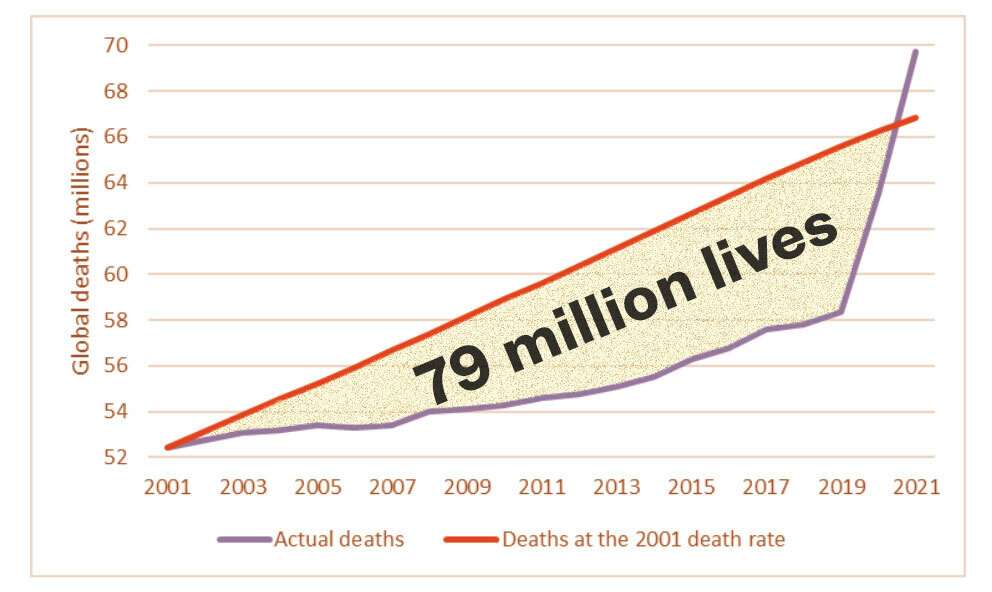
The Lancet study claims USAID programs saved more than 90 million lives during this period. In other words, USAID was allegedly responsible for the entire global improvement in mortality, plus another 11 million lives.
If you drill down into the numbers, the claim gets even more absurd. Most of the mortality decline (47 million of the 79 million) occurred in China, which received only 73 cents per capita annually from USAID. The least developed countries—the ones with the highest per capita USAID spending—actually saw an increase in mortality of 8 million during the study period, thanks to higher average death rates from 2001 to 2021.
Even if you believe that foreign aid is the primary cause of the declining death rate, these numbers make no sense. USAID comprises about 60 percent of U.S. foreign aid, and the U.S. contributes about a third of all government aid worldwide. Private cross-border charity dwarfs the USAID budget. Was all that money wasted while USAID funds were well-spent? Did advances in medicine, agriculture, public health, and economic growth have no role?
Anyone claiming that USAID was the sole source of declining global mortality during the two decades covered by The Lancet study bears a tremendous burden of proof. Yet the study does not provide convincing evidence of any mortality reduction attributable to USAID.
Studies of this sort often involve problematic data, plagued by missing values, inaccurate numbers, and changes in definitions. Such data require complex processing. To avoid reporting risible results, researchers must do constant reality checks. If simple analysis reveals an effect, more complex methods can refine it, making the result more certain and precise. But when simple methods show no effect, as in this case, it is dangerous to rely entirely on complex methods whose results defy common sense.
The authors of the study began with a common academic approach called “regression analysis.” They compared average mortality declines in countries with little or no per capita USAID spending to declines in countries with high per capita USAID spending.
Regression analysis shows only correlation, which does not demonstrate causation. Most researchers are careful to note this distinction. But Macinko et al. claimed their analysis showed USAID caused mortality declines, which is statistically impossible.
That assumption is particularly problematic in this case because a lot of USAID spending went to the same countries that also get aid from other sources. Effectively, the authors gave USAID credit for all the aid that countries received, no matter the source.
In any case, simple regression analysis did not demonstrate any correlation between per capita USAID spending and mortality declines.
For four of the 21 years in their study, Macinko et al. used “dummy variables” to ignore data showing USAID was associated with mortality increases. Their excuses for excluding two of the four years were the 2008 global economic shock and the 2020 COVID-19 pandemic. So why exclude the remaining two? “To adjust for major economic and health shocks,” the authors say, with no clue about what those shocks were and why they were more important than shocks in other years.
It’s not clear why shocks should be ignored in the first place. Does it not matter that USAID recipient countries were hit harder by COVID and the global financial crisis than other countries? Does USAID only save lives in calm times and cost lives in turbulent ones? If so, don’t we care about the net lives saved or lost at all times?
Next, the researchers tested 48 “control variables.” The purpose of these adjustments is to account for factors unrelated to USAID spending that affect mortality rates. Unfortunately, in this case, there are no good controls. For example, the study included education spending and the availability of piped water; however, since USAID funds education and water infrastructure, these factors are related to the amount of USAID received. All the control variables tested were things affected by USAID spending.
Including controls that are causally linked to your main variable of interest—USAID spending in this case—can cause illusory effects to appear statistically significant. This is particularly problematic when you select a large number of control variables relative to the number of data points and choose those control variables from a long list of candidates.
Macinko et al. did not preregister their controls, meaning they did not publish a research plan that committed them to a particular set. That safeguard aims to prevent researchers from falling prey to the temptation of selecting control variables based on whether the results align with their preconceptions.
What about the estimate that the Trump administration’s USAID cuts, if continued, will result in 14 million preventable deaths by 2030? Programs like USAID have numerous consequences, both positive and negative, and it is impossible to accurately calculate or project their impact with any confidence. Pretending to have scientific confidence in a quantitatively dubious measure, such as lives saved, is irresponsible and leads to a loss of trust in science.
The Lancet study seems designed to generate a partisan talking point, suggesting that anyone who supports the Trump administration’s actions values 18 cents over 90 million lives. Note the trick of making the cost look small by dividing it among 150 million U.S. taxpayers and 365 days per year while making the benefit look large by totaling it over the entire globe for 21 years.
This study has nothing to do with science. It waves the bloody shirt while feigning scientific detachment.
The post Did USAID Really Save 90 Million Lives? Not Unless It Raised the Dead appeared first on Reason.com.
]]>Not since the end of the Cold War has the concept of multipolarity been more salient as the global community continues to grapple with COVID-19. The pandemic has become a threat multiplier, cascading from a health and socio-economic crisis to a political and security crisis as countries turn inward and adopt more populist and nationalistic policies. Since the outbreak of the pandemic a year ago, the call for global solidarity and deeper multilateral efforts to combat it has gained momentum across the globe.
Political leaders in Asia have joined the global community in stressing the importance of collective action against this shared threat, but evidence of greater multilateral cooperation has not met expectations. The absence of global leadership amid major-power rivalry has resulted in a doubling down on self-interest rather than collaboration. Meanwhile, the rigidity of the world’s multilateral institutions makes them no longer fit for purpose in dealing with 21st century economic and security challenges.
Despite this, a reinvigorated multilateral system remains the only way for the international community to respond to transnational threats such as climate change and pandemics.
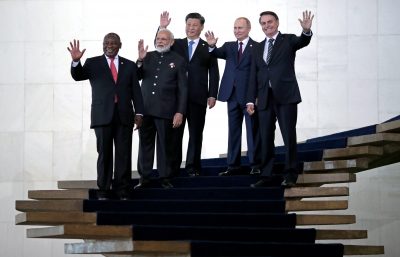
Much has changed in the multipolar order that defined international political and economic relations after the Cold War. While international politics is still influenced by superpower rivalry — this time between the United States and China — expanded ‘poles’ of power and influence have appeared as the European Union and emerging economies like Brazil, Russia, India, China and South Africa (the BRICS) hold increased economic clout.
The extent to which these poles have the power to influence the international economic order depends on how coherent their interests are in effecting change in the global economic agenda. BRICS countries for example, have pushed to reform institutions like the IMF to gain more voting rights but so far with only limited success.
The expansion of the G7 to the G20 is another indication of the realignment of interests among the diverse set of actors which intend to shape the contours of a new economic architecture. These changes have led to the notion of a ‘G-Zero’ world where no single country or bloc of countries has all the political and economic power to drive the international agenda.
Regions now play an increasingly important role due to the ‘spaghetti bowl’ of regional free trade agreements (FTAs), including the Asian mega-FTAs like the Comprehensive and Progressive Trans-Pacific Partnership (CPTPP) and the Regional Comprehensive Economic Partnership (RCEP). Though Japan and ASEAN countries are taking the lead in the CPTPP and RCEP respectively, the diverse interests of member states mean that the goals of each trade bloc are diverse.
It’s still unclear how a big power like China might wield influence over RCEP, not to mention through its lead in creating multilateral financial institutions like the Asian Infrastructure Investment Bank and Belt and Road Initiative. These new arrangements and organisations are seen as less ‘Western centric’ and impose fewer conditions while being more sensitive to the ideological diversity of recipients and members.
The problems of coherence and divided interests can be mitigated if competing multilateral institutions channel efforts into common goals, particularly in addressing threats to global public goods like health, environmental and food security.
For instance, in tackling the COVID-19 pandemic, global and regional institutions are both important actors, providing assistance, resources and expertise to countries struggling to contain the virus.
As the largest economy in Asia, China has filled the supply gaps caused by vaccine nationalism by distributing vaccines to developing countries, which are acutely disadvantaged by export restrictions and limited vaccine supply. Thus, the capacity of multilateral institutions and networks, particularly those in Asia, presents a potential reservoir of resources that can be deployed to tackle a range of regional and global challenges.
The dynamics of a multipolar order are not limited to coalitions of the willing and the proliferation of plurilateral trade arrangements. The growing influence of big tech companies like Google and Facebook that have the capacity to change the rules of the game — especially given their dominance in the global markets and lack of regulatory frameworks — cannot be ignored.
Private foundations like the Bill and Melinda Gates Foundation have also contributed significantly to the fight against communicable diseases like tuberculosis, malaria and HIV/AIDS while spearheading research into COVID-19 vaccines and therapeutics. Similarly, civil society organisations are working both regionally and locally to help communities cope with natural disasters, which are increasing in frequency as a result of climate change and disproportionately affect vulnerable groups.
The complexity of the transnational issues confronting the world today underscores the growing interdependence of states and societies. These challenges are reshaping a multipolar order that is more diverse yet more connected, with a growing number of actors claiming influence over global governance. In such a world, regional institutions like ASEAN are important in fostering cooperation and promoting multilateralism. Civil society organisations and private actors also play a valuable role, together offering more pathways for development, peace and security.
Mely Caballero-Anthony is Professor of International Relations and Head of the Centre for Non-Traditional Security Studies (NTS Centre) at the S Rajaratnam School of International Studies (RSIS), Nanyang Technological University, Singapore.
An extended version of this article appears in the most recent edition of East Asia Forum Quarterly, ‘Reinventing global trade’, Vol. 13, No 2.
The post Towards a multipolar order post-pandemic first appeared on East Asia Forum.
]]>