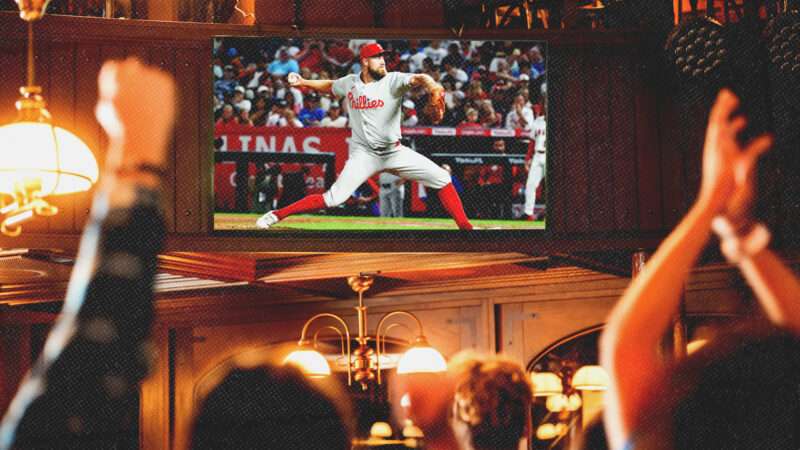
Hello and welcome to another edition of Free Agent! Jason has been placed on the PUP (physically unable to publish) list this week, so I’ve been called up for a spot start.
Real football doesn’t start for another week (and “week zero” of college football is mostly nonsense), which means this is still baseball season, baby. Watching America’s pastime has actually never been more affordable, despite those $15 beers at Nationals Park. Sharpen your pencils and grab your scorebooks.
As I said, real football starts next week—and you can join the fun by signing up for the one and only official Reason survivor pool. Don’t be lame, do it.
Locker Room Links
- Federal prosecutors have accused Daejon Labrayae Love of posing as a fake player for the San Francisco 49ers as part of a scam that defrauded more than two dozen women out of more than $1.3 million. Love allegedly “had romantic relationships with many of the victims and told them he wanted to build wealth and a future together,” before asking them to take out personal loans to invest in “nonexistent investment vehicles.” Getting deeply invested in a scenario that ultimately fails to reward you? Every 49ers fan under 35 can relate.
- Novak Djokovic was upset in the first round of the U.S. Open by Mariano Navone in a match that lasted more than four and a half hours and included at least one puke break for the 24-time major champion, who said afterward that “I didn’t enjoy myself.” Checks out.
- End of an era: Lionel Messi says he is retiring from international soccer. Messi was the first player to score 20 career World Cup goals (though France’s Kylian Mbappe has already surpassed his scoring mark). See them all here.
- The end of a different era: ESPN is phasing out its “BottomLine” score and stat ticker—probably because we’re all already checking the scores and stats on our phones.
- A bunch of kids from Curaçao, a nation of about 150,000 people, won the Little League World Series for the second time.
- Folarin Balogun, the breakout star of America’s World Cup run this summer, will be playing in the English Premier League this season. Everton purchased Balogun’s contract from Monaco for a reported 40 million pounds (about $54 million).
- Elsewhere in Reason, Nick Gillespie explains how the 2006 film Idiocracy predicted the future—and maybe offers some hope too?
- Did you have a bad week? Buck up, at least you didn’t commit an error in six consecutive games like New York Yankees shortstop George Lombard Jr. (Adding injury to insult, Lombard also tweaked his knee and could miss a few games, although maybe that’s for the best.)
This hasn’t happened to a Yankees player in more than a century
George Lombard Jr. has committed an error in 6 straight games, the longest streak by a Yankee since Chick Fewster in 1921. pic.twitter.com/S58qmwsZLE
— ESPN Insights (@ESPNInsights) August 28, 2026

More Baseball for Fewer Bucks
It’s popular to complain about how much more expensive life has gotten—and I get it, high inflation sucks. But while it is easy to notice when prices increase or when the quality of goods and services erodes, it is often more difficult to quantify the abundance of modern life relative to the recent past.
Sports fans are probably more aware of those changes than a lot of other people. Many of us remember the dark days when the Red Zone channel didn’t exist and when not every NCAA Tournament game was on TV. Still, quantifying this stuff can be pretty staggering.
A few years ago, the economist Gale Pooley offered this comparison on his Substack: “A ticket to a Yankees game in 1923 cost $1.10. Unskilled workers back then were earning 22 cents an hour so it took them five hours of work to earn the money to buy a ticket. Blue-collar workers were earning 44 cents an hour so it only took them 2.5 hours.”
Of course, in 1923 there was no other way to watch the Yankees except at the ballpark. Today, the average wage in the U.S. is about $37 per hour, and a full season subscription to MLB.TV costs $149.99. That means that less than five hours of work can buy you a virtual ticket to every Major League Baseball game played this season (minus the blackouts and in-market games).
Or, as Pooley put it: “Enjoying baseball has become 242,000 percent more abundant.”
Yes, there are diminishing returns to getting 2,400 baseball games on your television. But this is a service that the richest person on the planet in 1920 (or 1950 or 1980) could not have bought at any price, and you can get it for less than a full day’s work. Inflation is bad, and politicians should stop pursuing policies that worsen it. Still, the best way to see how astonishingly wealthy modern America is is to notice the remarkable things we take for granted.
Playoffs Are for Winners
There are just four weeks left in the MLB season—and your team is probably still in the race, at least if it resides in the American League. Aside from Tampa Bay, Boston, and New York, the rest of the league is so mediocre that a team with a losing record might make the playoffs for the first time in baseball history. This happens routinely in the NBA and occasionally in the NFL, but it feels particularly gross in baseball because the 162-game regular season is supposed to be more meaningful and, historically, making the playoffs was more difficult than in other sports. Should baseball change its rules to prevent this from happening (in the future, no changes can be made this year)? ESPN’s Bradford Doolittle has some ideas, and the first one is pretty good: Simply don’t allow it.
“You have just five teams reach the .500 mark in a league? Fine,” he writes. “You get five playoff spots. The team that otherwise would have played a seed held by a losing team advances to the next round.”
Yes, this would obviously mess up the TV contracts by potentially reducing the number of playoff series. But I’d be even more radical about this idea. Make the cutoff something like “12 games behind the team with the best record.” So if the best team in your league wins 97 games, every other team needs 85 wins to qualify. Then draw up a bracket based on however many teams clear the bar.
Added bonus: that means the team on top can knock out potential playoff teams by winning otherwise meaningless games in the season’s final weeks—each win raises the bar for the stragglers. If you can’t stay within 12 games over the course of 162, sorry, you don’t deserve a crack at the championship.
That’ll never happen, but it should. (Tweet me your own crazy suggestions.)
A related point: There is going to be major offseason drama in MLB as the players and owners negotiate a new collective bargaining agreement. The widespread assumption is that the owners will try to implement a salary cap (in one form or another) to limit how much big market teams like the Los Angeles Dodgers and New York Mets can spend. But doesn’t the extreme parity in the American League suggest that the playing field is already pretty level under the current system?
Swing and a Miss
It looks like the Tampa Bay Rays will finally get their long-sought-after new ballpark, as the Hillsborough County Commission gave its final stamp of approval to a subsidy plan that will see the public kicking in about $2 billion in tax breaks and other goodies.
But here’s the real insult to the taxpaying public of the greater Tampa area. Just moments after voting for the subsidy package, Commissioner Chris Boles explained that his decision was motivated by The Giving Tree—otherwise known as the worst children’s book ever written—and then went on to admit that he completely misunderstands his own metaphor.
“You have a seed, and you let it grow, and it gives back over time, and it does all these things,” Boles said. “And in a way, this park is like the Giving Tree.”
As Neil deMause notes at his Field of Schemes blog, that is not at all how The Giving Tree goes: “The boy protagonist doesn’t plant the seed that turns into the tree, he just shows up, finds the tree in the first, eats its apples, climbs its trunk, ultimately cuts it down, and then as an old man sits on its stump.”
In this case, I’m afraid the taxpayers of Hillsborough County are the metaphorical tree.
The Next Indiana
OK, we can’t make the whole newsletter about baseball.
In the era of transfer windows and Name, Image, and Likeness money, which school has the best shot at duplicating Indiana’s incredible turnaround from Big 10 doormat to national champions? How about Thomas Jefferson’s very own University of Virginia
Virginia smoked N.C. State, 34–6, in one of the marquee-ish games of the opening week of the college football season, and The Athletic‘s Ralph D. Russo tabs them as a possible Cinderella story this season. “A straight line can be drawn from Indiana to Virginia when it comes to roster-building strategy. It’s all about experience, production and fit when coach Tony Elliott’s program dips into the portal,” he writes. Or maybe another basketball blueblood, Kentucky, can also make the leap to football powerhouse?
Such underdog runs are amazing because they are so rare, so don’t get your hopes up. For what it’s worth, ESPN’s college football simulations give Virginia a 1.7 percent chance of winning it all. Kentucky, meanwhile, has only a 1 percent chance of topping the SEC. Dare to dream, kids!
Replay of the Week
As a Phillies fan, I am admittedly a little biased here—but their 9th inning in Anaheim on Friday night included a game-saving home run robbery followed by a game-winning grand slam. Have you EVER seen that before?!
All the swings of emotion during an outrageous top of the 9th in Anaheim
pic.twitter.com/S71Dd50G7t
— MLB (@MLB) August 29, 2026
That’s all for this week. Enjoy watching the real games of the weekend: The Minnesota state amateur baseball championships, which continue through Labor Day.
The post 2,400 Baseball Games for the Price of 1 appeared first on Reason.com.
]]>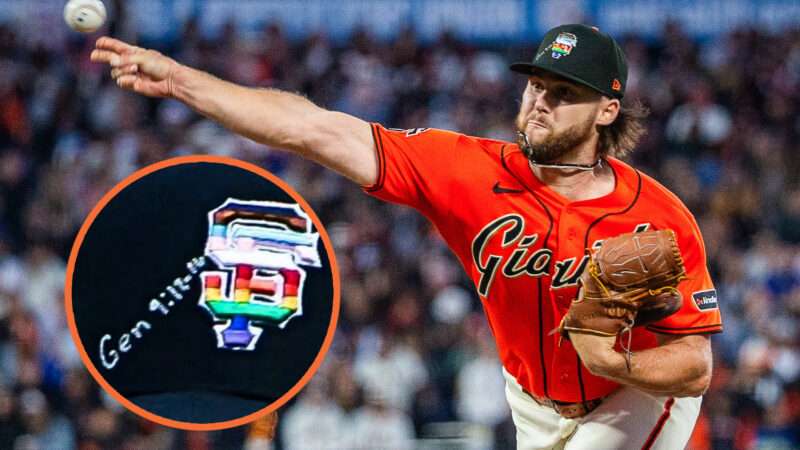
Major League Baseball (MLB) found itself mired in controversy this past week after three San Francisco Giants players—Landen Roupp, J.T. Brubaker, and Ryan Walker—inscribed Bible verses on their hats that had been designed for the team’s Pride night. Another, Sam Hentges, declined to wear the hat altogether. Whether people were mad at the players for their lack of pride or at the team and league for their alleged abundance of pride depends on vantage point. But people were mad.
Put differently, we are living in Groundhog Day, but make it gay. We’ve had this fight before. Around and around we have gone. A lot of people are wrong. So why are we still doing this?
The MLB may be wondering the same thing. “We have told teams, in terms of actual uniforms, hats, bases that we don’t think putting logos on them is a good idea just because of the desire to protect players,” said MLB commissioner Rob Manfred in 2023, “not putting them in a position of doing something that may make them uncomfortable because of their personal views.” The Giants and the Los Angeles Dodgers, however, have continued incorporating the Pride uniforms because of a standing agreement.
This fight is not constrained to the outfield or the infield or the minefield-ridden culture war battlefield. “I write with grave concern over your reported decision to issue a formal warning to three Major League Baseball (MLB) players for publicly expressing their Christian faith,” Sen. Josh Hawley (R–Mo.) said in a letter to Manfred. “You must answer for what appears to be a pattern of discrimination within MLB against baseball players who profess their Christian faith.” The senator was joined by other government actors promising to intervene, including the U.S. Department of Justice’s Harmeet Dhillon, who referred the league to the Equal Employment Opportunity Commission for an investigation.
“This routine verbal warning not to wear the hat in future games is not disciplinary and had absolutely nothing to do with the content of the message,” the league said in a statement. “We respect players’ right to free expression. However, writing of any kind, with any message, is prohibited per Major League Baseball’s uniform regulations….We have given the same warning numerous times in the past to players for messages such as ‘Dad,’ ‘Happy Mother’s Day, I Love Mom’ and names of family members.”
Dear reader, you are entitled to the view that such a policy is silly. You are also entitled to the view that teams could and should avoid this carousel ride of controversy altogether by not politicizing uniforms. But the MLB’s rule is unequivocally, uncontroversially protected by the First Amendment. Yes, the league receives subsidies (too many, in fact!). So do many private organizations and companies: Amazon, Intel, Boeing, Ford, tech companies and agricultural companies and energy companies and on. That does not mean they forfeit their constitutional rights. Baseball is a symbol of Americana, after all. Appropriately, it is not an arm of the U.S. government.
One person who provides a good reminder that this is constitutionally protected is, ironically, Dhillon. “The Civil Rights Act prohibits MLB and its franchises from unreasonably burdening the rights of players with religious objections to serving as the League’s vehicle for pro-Pride messages,” she writes in her letter. “Federal law is clear: employers must modify their uniform requirements to reasonably accommodate their employees’ exercise of religion.”
They did. The Pride hats were not mandatory; Hentges opted out, which players are permitted to do, and he thus received no verbal warning. That is “reasonably accommodat[ing]” by every measure. A team offered its employees clothing that aligned with its values and the league enforced rules it has about writing messages on uniforms—two things that are indisputably within the purview of private actors. If a franchise gave players hats inscribed with the Ichthys (a.k.a. the Jesus fish), it would be similarly vindicated in admonishing employees who added anti-religious screeds.
The difference, of course, is that an MLB team offering such a hat would be nearly beyond belief, including (maybe even more so?) to the devoutly religious. Which does tell you something.
Teams are working toward a collective. But they are made up of individuals. Some players are religious, some are not. Some support gay rights, some do not. Some believe ranch dressing is the best condiment, some have no taste. This is, fortunately, their right. “I’m thankful we live in a country where, you know, we have the freedom to believe what we want…and express what we want,” Roupp said after the game last week. Pressuring players under a national microscope to take sides on any given political issue mostly just breeds conflict for the sake of virtue signaling. And for what? Expressions of support—for gay rights, or for anything—mean much more when they are done voluntarily, by your own initiative, on your own time.
“By resorting to ‘us’ and ‘them’ instead of truly understanding the humanity of the people asking for help, those who chose to make a statement on or with their hats completely missed the point,” wrote Grant Brisbee in a viral column for The Athletic, a subsidiary of The New York Times. “If anyone is looking to make the world better, they might try listening and understanding.” The author, respectfully, could stand to take his own advice.
The post Major League Baseball Teams Have the Right To Offer Pride Uniforms. Should They? appeared first on Reason.com.
]]>
Hello and welcome to another edition of Free Agent! Happy St. Patrick’s Day, have a Guinness or two (or 10).
Before we start, I want to make sure you know about our March Madness bracket groups. Click here for the men’s bracket group, and click here for the women’s one. Alas, there’s no monetary prize for winning this year, but it’ll be fun to see how your bracket compares to Reason staffers (several colleagues who don’t like sports usually join in) and fellow subscribers.
This edition also marks Free Agent‘s first anniversary. No gifts necessary, you can just forward this newsletter to a friend who might enjoy it, or send them straight to our subscription page. It’s been a really fun year—many thanks to all of you for reading and subscribing!
With that, let’s get into the World Baseball Classic, sports betting, legendary sports moments, and, unfortunately, a debate about sexy sports.
Locker Room Links
- Days before March Madness, Alabama’s Aden Holloway is suspended indefinitely after getting arrested for allegedly dealing marijuana.
- After Venezuela reached the World Baseball Classic final, President Donald Trump posted on social media, “STATEHOOD, #51, ANYONE?“
- Washington state is implementing an income tax on millionaires. “It’s gonna sting” in free agency, the Seahawks general manager said. Maybe a flat tax is the way to go?
- Next week NBA owners will vote on exploring expansion—but only in Las Vegas and Seattle.
- How lobbyists for the Portland Trail Blazers pressured politicians into spending $400 million on the team’s city-owned arena.
- Formula 1 canceled two races because of the Middle East war—the races had been planned for Bahrain and Saudi Arabia.
- The White House is posting more bombing videos from the war, now interspersed with footage from Wii Sports.
- J.C. Tretter resigned from the NFL Players Association in shame back in July—now he might get the union’s top job anyway.
- The Reason team was shocked and saddened last week by the death of our longtime colleague Brian Doherty. Brian’s work with Reason spanned four decades, a long and unmatched journalism career: from interviewing Milton Friedman in the ’90s, to chronicling the rise of libertarian Rep. Ron Paul in the 2000s, to countering antigun misinformation in the 2010s, to profiling Elon Musk’s MAGA turn in the 2020s, and many more timeless pieces I don’t have room to list. It’s a terrible loss for Reason, and for everyone who believes in freedom for all.
A farewell to our colleague Brian Doherty, dead at 57 https://t.co/vNY3iVvTqf
— reason (@reason) March 14, 2026
For Every Sport, a World Cup?
If there’s one thing most people seem to feel strongly about, it’s geography. The place they’re from? It’s better than the place you’re from. That goes whether it’s players from who-knows-where playing on their local professional sports team, or their fellow citizens playing on a team representing their country, or whatever kind of pizza their city is famous for.
Those strong feelings are why every sport would be wise to have a World Cup of some kind.
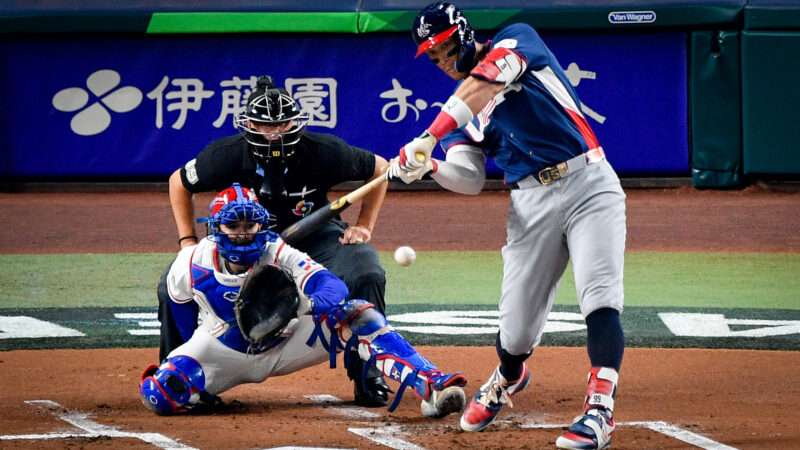
We’re seeing it now with the World Baseball Classic. The Marlins can’t give enough tickets away to fill their ballpark, but if you just pit the Dominican Republic against Venezuela there with some stakes on the line, you’ll see a $300 get-in price. At some point, MLB started to realize it had a potential hit on its hands—games went from being hidden on MLB Network to shown on FOX, they added more teams and more games, and higher-quality players started opting in, too.
The NHL is ramping up its international involvement, too, with pros finally back in the Olympics and the NHL bringing back the World Cup of Hockey and taking it more seriously. Flag football at the 2028 Olympics has the NFL’s blessing. (The NBA seems to be missing the boat—perhaps because the Basketball World Cup is organized by FIBA and not the league itself, so there’s not much of a direct financial benefit.)
It’s a great way to grow sports internationally. What’s better? Staging a game abroad between two teams that foreigners have little attachment to, or staging a competitive game with a team of players from their country? Foreigners are obviously going to be more interested in following the latter long-term.
Even though these are competitions with a winner and many losers, they generally don’t sow actual hatred between different countries. Maybe you skipped the Canadian maple syrup during the Olympics, but now you wouldn’t think twice about it.
International competition gets players and fans excited—they care about the stakes, unlike in most All-Star Games. They give people something new to watch and care about, and are clearly a great avenue to deepen fandoms. Whatever sport it might be, leaders would be wise to figure out a way to get more of a focus on international team competitions.
Betting With Company Dollars
Lots of talk online last week about The Atlantic‘s new cover story, in which the magazine gave staff writer McKay Coppins $10,000 to gamble on sports during the most recent NFL season. The headline on the cover is “My Year as a Degenerate Gambler,” in case you had any hopes of it being a fair and balanced piece (also, fact check: the NFL season was less than six months long, not a “year”).
Coppins is a strong writer, and I can see why readers were drawn to his personal experience. He starts as a reluctant Mormon, begrudgingly participating in gambling for the sake of good journalism, before the betting devolves into an obsession that’s a strain on his family life.
But as someone who’s read every scolding “here’s how this person ruined their life through sports betting” article out there, I was disappointed. Thirteen thousand words and I didn’t see any new arguments I hadn’t heard before, or learned anything new other than “Don’t ask McKay Coppins for betting advice.” (I learned much more from a better and shorter Atlantic piece published over the weekend, “The Cure for Snoring“).
Coppins finishes the season having lost $9,891 of The Atlantic‘s money. While tempted to keep betting, he decides to fill out a self-exclusion form that bans himself from it instead. The takeaway for most readers, it seems, is that the pull of sports betting is too strong for mere mortals to deal with and must be stopped.
My takeaway is different. People should bet for fun. If they’re not having fun, they’re probably trying too hard to get rich quick (or make up for financial losses), which will probably make them poor and unhappy. The law should treat adults as capable of making choices that are best for them, even though a small fraction of the population will cause problems for themselves while everyone else is having fun. While the public narrative seems to think more and more people are getting consumed by sports betting’s temptations, there’s ample evidence that the number of people betting has plateaued.
Thankfully, defenders of betting got good news this week when a new poll found legalized sports betting has more supporters than opponents.
The best rebuttal to the piece, though, is all around you this week: tens of millions of people casually betting with their friends in March Madness bracket pools.
Legends Never Die
Is anything in sports truly legendary anymore?
There’s an interesting case study to be had about nothing in sports feeling legendary anymore. I don’t think it’s a nostalgia thing at all, I think it’s the rise of social media and accessibility so we move on from everything immediately.
— ⁸???????????????????? (@33643pts) March 11, 2026
It’s a sentiment that I sympathize with at times, but I think is totally wrong. When you grow up hearing about legends of the distant past like Babe Ruth and Gordie Howe, it’s easy to miss the fact that you’ve seen the legends of today’s era like LeBron James and Tom Brady. It’s also a weird sentiment to share after the whole country just celebrated a legendary moment thanks to the U.S. men’s hockey team (it was no Miracle on Ice, sure, but it captured the country’s attention for a week).
To be fair, some of this feeling is because of how quickly the news cycle moves. Before the last piece of confetti has been cleaned up, The Athletic and ESPN have “Way-Too-Early” power rankings ready for next season, and a free agency preview to keep your mind thinking forward instead of reveling in the champion’s glory. Yet I’m more likely to click on those early rankings to see how my team stacks up for next year rather than read about the in-depth profile of how some team I don’t care for finally won their title (or worse, did it again).
It’s fine to feel nostalgic about sports (unless you’re a politician thinking about subsidizing a stadium), but don’t let nostalgia cloud your appreciation for the amazing sports moments surrounding you. It’s easier than ever to enjoy all kinds of sports, and sports fans should be incredibly thankful for that.
Sports, Sexy? (Sorry.)
I regret to inform you that this post inspired a vigorous conversation at Reason on which sports are and aren’t sexy, and that I’ve been told this list would make good content.
Skiing is sexy and bowling isn't https://t.co/lCwJcP42kc
— Josh Barro (@jbarro) March 11, 2026
Sexy sports: Skiing, swimming, billiards, tennis, basketball, soccer, curling(?), gymnastics, biathlon (“The guns make it sexy”), field hockey, speed skating, luge (“uncomfortably sexy”)

Not sexy sports: Bowling, hiking, cross country, golf, football, table tennis, wrestling, cricket, competitive weightlifting, chess (unless it’s chess boxing), squash, pickleball (“too many olds”), quidditch (“unsexy to consider it a sport”).

In between: baseball (“only if you’re into dadbods“), equestrian sports (“I don’t want to call a sport with a horse sexy” vs. the outfits), ice hockey (“if you like no teeth“), rugby (“incredible thighs” vs. bleeding ears), water polo, fencing (“inherently sexy, but unsexy uniforms”).

(Sports are not ranked by sexiness, just listed in the same order they came up in our bonkers conversation.)
If you have thoughts on which sports are sexy and which aren’t, I beg you to email me about anything else at freeagent@reason.com.
In all seriousness, to answer the original question of why skiing gets more media coverage than bowling, I suspect it’s because skiing happens in ski-specific resort towns and other centralized areas that have newsworthy stories connected to economics, politics, environmentalism, and travel. Bowling just happens down the street from everybody.
Replay of the Week
You’re going to want to see this one from multiple angles.
WHAT DID WE JUST WITNESS? pic.twitter.com/EKguhwjeFA
— Sportsnet (@Sportsnet) March 13, 2026
That’s all for this week. Don’t forget to join the bracket groups! Click here for the men’s bracket group, and click here for the women’s one. Enjoy watching the real game of the week in an even older bracket competition, Detroit City F.C. against the Michigan Rangers on Tuesday night in soccer’s U.S. Open Cup.
The post Should Every Sport Have Some Kind of World Cup? appeared first on Reason.com.
]]>
Political activists already treat elections like team sports, fanatically rooting for Team Red or Team Blue regardless of ever-changing ideologies—so why not watch and bet on actual team sports instead?
The stakes are a lot lower in sports. No one gets deported if Michigan beats Ohio State three times in a row (fortunately for head coach Ryan Day). Inflation won’t rise if long-suffering carpetbagger Yankees fans ever get to celebrate another World Series title. Sports don’t really change public policy at all, since the Nashville Metropolitan Council has shown local governments are willing to shell out $1 billion for shiny new stadiums even for hapless teams like the Tennessee Titans.
But if the stakes in team sports are actually too low for you, you might as well put a $5 bet down on a random game to get yourself interested.
Moneyline bets on a game’s outright winner are my preference when betting—it’s good to have the team’s incentives aligned with mine, unlike over/under bets on combined score or player prop bets on individual performances. But layers upon layers of betting options are available if a straight-up bet doesn’t strike your fancy.
You could bet on James Madison University to score in every quarter of its next game. You could bet on Arsenal to score exactly one goal in the first half of their match against Inter Milan. You could bet on a Dylan Larkin hat trick. You could bet on Fremantle to “win the flag” in the Australian Football League (apparently that means to win the championship).
I am absolutely not saying any of those bets will be winners (especially Fremantle, who I picked just because they have a cool name). But winning money off the bets isn’t the point; it’s the enjoyment you get from watching and having a vested interest in the outcome of the bet—winning your money back plus a little extra is just a nice bonus. Wouldn’t it be fun to spend 2025 following Fremantle’s season? Would you do that if you didn’t have a $5 bet on them to win the flag? Wouldn’t your friends think it was cool that you got into a random Aussie rules football team? (OK, some might think it was weird.)
If you’re just betting a little money, a multileg parlay is a fun way to combine action on a few bets in hopes of scoring a bigger payday (but the house’s cut is bigger on parlays, so they’re not a good long-term strategy). Your $5 bet will be a lot more likely to go down the drain, but there’s a small chance for it to be multiplied many times over.
Thankfully, if you do prefer politics to sports, betting on the election is now legal in America—a federal appeals court ruled that the Commodity Futures Trading Commission failed to prove that election betting was a threat to election integrity. Platforms such as Polymarket and Kalshi offer bets on the Electoral College winner, popular vote winner, the margins of those votes, the balance of power in Congress, and much more, even outside of politics.
Maybe all this sounds like a crazy way to lose money that can only lead to financial ruin. Perhaps that’s true for the rare few who fall into gambling addiction, but even those people are mostly losing their own money. Politicians are addicted to losing billions of dollars of other people’s money every year, and far too few people ever bat an eye at it. Losing $5 on a dumb sports bet pales in comparison to $7.5 billion in government cash building just eight electric vehicle chargers in two and a half years.
Whose bet was worse, that or my $5 bet on Fremantle? (Go Dockers!)
The post To Get Through This Election, Bet on Sports appeared first on Reason.com.
]]>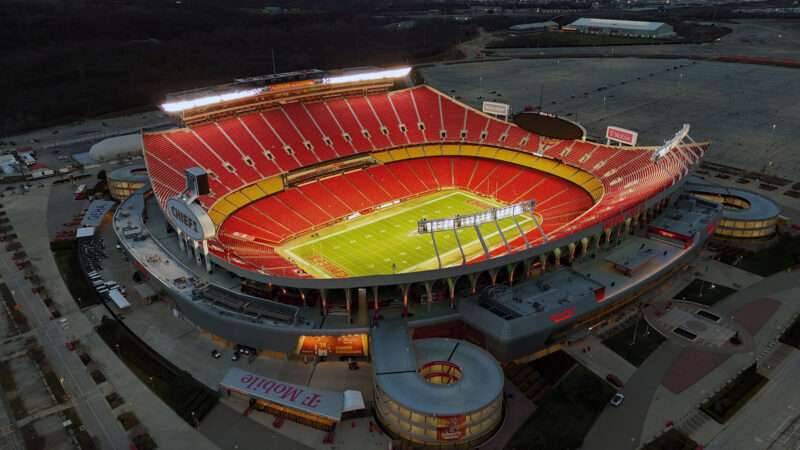
Professional sports team owners are at it again. This time, it’s the Kansas City Chiefs and the Kansas City Royals who want fans—along with their fellow taxpayers who may be indifferent toward sports—to help with their business expenditures. Early voting has already begun as Jackson County prepares to decide whether to partially fund the teams’ stadium plans or potentially lose the teams to another city.
The Chiefs proposed $800 million in renovations to the GEHA Field at Arrowhead Stadium, of which the owners will only pay $300 million. The Royals, meanwhile, announced in February plans for a brand new stadium estimated to cost $2 billion, only half of which is expected to be paid by the Royals in private funds.
The vote, which will conclude April 2, either will have residents opt to get rid of an existing sales tax that pays a portion of stadium operation fees or replace it with a new one—totaling approximately $2 billion and scheduled for over the course of 40 years—in order to pay a portion of the price. Each team would receive $27 million of tax money annually.
So what will happen if voters reject it? “We’d have to look at all our options,” said Mark Donovan, the president of the Chiefs. “I think they’d have to include leaving Kansas City.” His appeal may very well sway voters, considering there is a long history of these threats working in the city.
The Royals echoed Donovan’s thought: “There’s lots of cities that would love to have these franchises,” said John Sherman, the majority owner of the Royals. And the Committee to Keep the Chiefs and Royals in Jackson County noted that “if the vote doesn’t pass, both teams will consider all options.”
But even though they insist these taxes are necessary, it’s difficult not to see their threats as a way to scare voters into coughing up taxpayer dollars so both teams can save private funds. Leaked documents indicate that taxpayers could end up paying up to $5.1 billion over four decades—far more than the teams’ estimate.
The sports giants are in fact so keen to save every penny that a $1 million request by Jackson County Executive Frank White Jr. to pay for the elections, in order to avoid taking funds from the city’s emergency reserve, has so far gone ignored by the teams. The initiative “poses a significant dilemma,” said White, “given our commitment to safeguarding the county’s financial stability.”
It’s worth noting that the Hunt family, who owns the Chiefs and whose fortune stems from oil tycoon H. L. Hunt, is worth nearly $25 billion, according to Forbes. Putting aside the questionable ethics of weaponizing local sports enthusiasm to save private funds, there is no clear reason why the owners can’t pay for the renovations themselves.
As for the Royals, the sales tax would cover only one-third of the stadium’s costs. The reason is far from encouraging. Most of the funds would go toward the county’s debts to Truman Sports Complex, as well as interest payments on the team’s construction loan, leaving “somewhere between $250 million and $350 million that can actually be used to cover stadium expenses.”
In other words, the public would be forced to pay the price for a private company’s mismanagement. Also dubious is the claim that the team needs a new stadium at all: A 2022 study concluded that the current Royals home turf, Kauffman Stadium, is in “satisfactory condition.”
Some small business owners are rallying against the stadiums, because, perhaps most infuriatingly, several such enterprises would be razed in the process of building the Royals stadium. “We’re all kind of dumbfounded right now, still, that they did choose this location,” said Matt Adkins, an owner of a wine bar and boutique grocery. “There’s literally something five blocks away [in the East Village] where they’re saying, ‘Please come over here instead.'”
When Donovan was asked about business owners’ apprehension about the effects the stadium reforms would have on the Crossroads district, he responded: “Change is hard, and there’s a lot of information that needs to get out there….We think downtown baseball is right for baseball.” OK. But does that make it right for the city and its residents?
The post Taxpayers Will Soon Find Out if They'll Have To Finance Fancy Stadiums for the Chiefs and the Royals appeared first on Reason.com.
]]>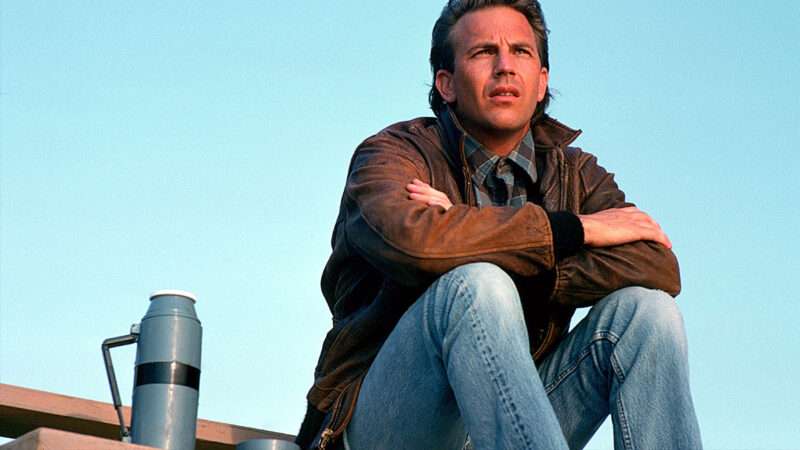
Ask a full-grown man why he’s choking back tears at the mere mention of the 1989 baseball fable Field of Dreams, and he is almost certain to cite the film’s famous final scene, in which 33-year-old Kevin Costner, voice at once hopefully boyish and soggy with the emotionalism of looming middle age, says to an anachronistically clad young ballplayer, “Hey, Dad? You wanna have a catch?”
While technically the answer to a series of supernatural riddles—at the movie’s outset, Costner’s character, Ray Kinsella, hears a disembodied voice in his Iowa cornfield repeating If you build it, he will come, after which he irrationally constructs a ballpark—the baseball-mediated reconciliation between the son and a younger version of his father resonates with anyone carrying unresolved conflict with a parent, or shame over youthful hotheadedness, or just bucolic memory of childhood sport. There’s a good reason that Field of Dreams is the third-highest-grossing baseball movie of all time (adjusted for inflation), and there’s a good reason it remains the go-to source at live games for inspirational audiovisual clips.
But there is another, more insidious piece of symbolism in that very same scene. As the camera pans out from the father-son reunion and into the twilit summer sky, we see a line of cars snaking in from miles around, fulfilling a prophecy delivered minutes before by the novelist character played by James Earl Jones: “People will come, Ray. They’ll come to Iowa for reasons they can’t even fathom. They’ll turn up in your driveway not knowing for sure why they’re doing it. They’ll arrive at your door as innocent as children, longing for the past. ‘Of course, we won’t mind if you look around,’ you’ll say. ‘It’s only $20 per person.’ They’ll pass over the money without even thinking about it.”
As prediction, let alone brazen self-reference, the speech is uncanny: People have indeed been coming by the thousands each year to the Dyersville, Iowa, farm and ballfield where the movie was shot. Major League Baseball (MLB) held special regular-season games there in 2021 and 2022, with the requisite Costner narration and players materializing like cinematic apparitions from the outfield cornstalks. Yet it’s not precisely the past these pilgrims are longing for, but rather an ersatz depiction of an idyll that never existed, one that neatly evades decades of messy, real-world dysfunction—in baseball, in America, within families.
By demonstrating that people will indeed shell out good money to feel nostalgia for make-believe, Field of Dreams helped create the template for the modern baseball industry: Build expensive, “retro”-looking stadiums and get taxpayers to foot the bill by selling them a mixture of gee-willikers Americana and economic analyses every bit as magical-realist as the source material. Camden Yards, the single most imitated construction project in MLB history, was funded with $482 million of public money (in 2022 terms) and greeted upon arrival in 1992 by The New York Times with the headline: “Field of Dreams Comes True in Baltimore.”
That Inner Harbor structure, with its throwback brick arches, 19th century cast-iron gates, and intentionally quirky asymmetry, was the opening salvo in a 25-stadium building boom financed by more than $9 billion in taxpayer money (in constant 2022 dollars), according to the Kennesaw State University sports economist J.C. Bradbury. The minor leagues, too, got into the act, so much so that state and local governments are on the hook for an estimated quarter-billion dollars in financing just for stadiums that now stand empty. “These partners have heard the message from the movie Field of Dreams: ‘If you build it, they will come,'” then–New Jersey Republican Gov. Christine Todd Whitman said in 2000 while breaking ground on a $24 million ballpark in Camden. “Soon we will see a field of dreams right here in Camden, and my prediction is they will come.” By 2015, after lease renegotiations with the city broke down, the Camden Riversharks independent minor league team folded.
The movie’s contrived nostalgia has implications broader than the forcible redistribution of general tax funds to a narrow and already profitable segment of the entertainment industry. Field of Dreams doesn’t just honor the cherished memories of our childhood; it insists that baseball back then, and therefore America itself, was better. “It reminds us of all that once was good, and could be again,” Jones’ character Terence Mann booms out, in a baritone that’s been heard at thousands of MLB games.
We have adjectives to describe the insistence on a superior past, and they tend toward the pejorative: vestigial, atavistic, reactionary. Exaltation of lost glory necessarily discounts the present; reimposing the ancien régime requires tossing aside today’s players, often with casual recklessness. Audiences embraced Field of Dreams because it’s a sumptuously shot, well-crafted movie with compelling actors and an Oscar-nominated score, yes, but also because they worried then—and continue to worry now—that something valuable is vanishing, that the best of baseball and the country of its birth is in the rearview mirror. That the only path to redemption is believing, twice as hard this time, in a fairy tale. One that narcissistically absolves our own active role in the decline.
Not OK, Boomer
Three of the four most popular baseball movies in history debuted within 39 months of each other—No. 4 Major League in April 1989, followed the next month by Field of Dreams, then No. 1 A League of Their Own in July 1992. Pull the periscope back a bit, and 10 of the top 15 Hollywood depictions of the national pastime (including such enduring films as Robert Redford’s sentimental The Natural and Costner’s bawdy Bull Durham) came out between 1984 and 1994. Why is that?
One clue lies in Costner’s scenery-chewing generation, the baby boomers. America’s birth rate peaked between 1946 and 1957 at levels higher than the previous two decades and never seen since. (Costner, who has yet a third movie in the hardball top 20, 1999’s For Love of the Game, was born in 1955.) Baseball, the oldest of American professional sports, was the undisputed king during boomer childhoods—the soundtrack of radio, the pioneer of television, crushing all contenders for public attention until the National Football League vaulted up in the mid-1960s. Baseball, hot dogs, apple pie, and Chevrolet, went the old commercial jingle: They go together in the good ol’ U.S.A.
Those core boomers were between 31 and 43 when Field of Dreams hit theaters, the perfect age for reminiscing about boyhood adventures, reflecting on life choices, reconsidering dear old dad…and relitigating the ’60s.
“I’ve always been interested in what do we do with the youthful ideals when we’re no longer youthful,” writer/director Phil Alden Robinson said in a 2019 interview, explaining why he recast Ray and his spunky wife Annie (played by Amy Madigan) as graduates from the Berkeley counterculture rather than products of America’s heartland, as they had been in Shoeless Joe, the 1982 W.P. Kinsella novel from which Field of Dreams was adapted. “For those who cut our teeth in the ’60s, and thought we were so groundbreaking and rule-breaking and iconoclastic, how do you carry that through into adulthood?” Robinson asked. “In a way, that’s what Ray’s story is about.”
As boomers began to seize the means of cultural production during the Reagan era, they clogged the bookshelves, airwaves, and theaters with expressions of nagging ambivalence about their own prosperity at a time when the Woodstock ethos was fading from view.
“In the late ’80s and early ’90s,” wrote Katie Arnold-Ratliff in a perceptive 2014 essay for Culture.org, “there arose a micro-genre of sincere but funny existentialist narratives, all featuring boomer-aged protagonists who attempted to clarify what really matters and pinpoint how one ought to live.” Besides Field of Dreams, Ratliff listed Peggy Sue Got Married (1986), Mr. Destiny (1990), L.A. Story (1991), Defending Your Life (1991), Groundhog Day (1993), and Heart and Souls (1993)—all movies where “a boomer, usually dissatisfied, interacts with a magical or supernatural force and, as a result, arrives at a conclusion about the meaning of life.” They were happy and successful on the surface, sure, but wasn’t there supposed to be something more?
Field of Dreams wastes little time plunging into the generation gap. In an introductory montage, as we see collegiate scenes of peace, love, and protest, a Costner voice-over explains that “officially my major was English, but really it was the ’60s.” (He means the early-’70s variety, Ray having been born in 1952.) “I marched, I smoked some grass, I tried to like sitar music, and I met Annie.” Not the deepest dip into revolutionary waters, but enough to make permanent the alienation from his heroic, widowed World War I–vet father, of whom Ray grudgingly allows, “I suppose Dad did the best he could.”
Near the end of the first act, Annie attends a raucous school board meeting to rebuff attempts by a local conservative busybody to ban a book by the aforementioned Terence Mann, coiner (fictitiously) of the slogan “Make love, not war.” Annie calls the book banner “Eva Braun” and a “Nazi cow,” but the sickest burn is that the frumpy scold didn’t experience “even a little bit of the ’60s.” When the hausfrau protests that she in fact had, Annie zings back: “I think you had two ’50s and moved right on into the ’70s!” Flushed with victory, Annie gushes to her husband (who is too myopically focused on his own quest to even register his wife’s triumph), “Was that great or what? God, it was just like the ’60s again!” (Subtle, this movie is not.)
When Ray locates the reclusive Mann (in the book, the character is literally J.D. Salinger), Jones comically attacks him with an insecticide sprayer: “Out! Back to the ’60s! Back! There’s no place for you here in the future! Get back while you still can!” Alas, that tonic acidity is destined to melt into a conciliatory goo.
The intended utility of that famous decade here is as undousable idealism, every bit as worthy of integrating into late-’80s adulthood as the quest to patch things up with Pop. By chasing his hallucinatory visions across the country, even as his neglected wife and kid fend off foreclosers back home, Ray reignites his sense of purpose, pulls a beloved writer back from bitter exile, and sets the stage to reconcile with his late father.
Or does he?
In an acerbic 2016 Inside the Kraken essay, Josh Kyu Saiewitz pointed out that Ray’s original beef against his dad is almost laughably immature: The old man went to war and got a job and raised a family responsibly instead of pursuing dreams of playing baseball. What a sellout!
Ray, on the other hand, “has no accomplishments and no ambitions,” no apparent clue how to farm, not even a contemporary rooting baseball interest, even though Iowa is home to a half-dozen minor league teams and two dozen college baseball programs and is within road trip driving distance of six MLB stadiums. His agonized plight is as “common as dirt for people his age,” Saiewitz contends. “Having missed out on his chance at greatness (or so he believes), Ray feels as though he sold his dreams and settled down for the kind of traditional family-and-job life he failed to fight against.”
In a just world, or at least a world able to consider non-boomer points of view, Ray would come back from his odyssey having learned enough humility to appreciate his dad’s selfless choices. And yet: “When Ray’s father’s ghost emerges to tentatively search for forgiveness,” Saiewitz writes, “he comes as a young man in a baseball uniform. If Ray is to forgive his father, shouldn’t he forgive the version of his father that he knew and failed to respect, not the version Ray wished his father had been?”
Field of Dreams, like so many coming-of-middle-age dramedies at the turn of the ’90s, wants to identify with and vaguely defend that 1963–74 tumult known as “the ’60s” without doing the hard work of asking whether all that self-absorption was really so noble.
Oh, God
It takes a while to put a finger on what feels out of place in Ray’s otherwise picturesque Iowa existence. Sure, Costner dresses more like Sting performing at Live Aid than anyone who works with machinery and dirt, but it’s understood that Ray’s a bit out of place. No, it’s the fact that Ray and Annie, and even their adorable daughter Karin (played by Gaby Hoffman in her cinematic debut), don’t have any visible friends.
In 2023, particularly after the damaging isolation of the COVID-19 pandemic, we understand much more viscerally the pathologies associated with loneliness, with the decline in community participation, and with the collapse in organized religion. People who do not interact at least semi-regularly with their neighbors, who have fervor aplenty but lack the channels for venting it, are like petri dishes for unhappiness and dysfunction.
Field of Dreams is a religious movie for atheists (“Is this heaven?” “It’s Iowa” is a recurring gag). It has oft been analogized to the prophetic dreaming of Joseph—he of the amazing technicolor coat—in the Book of Genesis, praised for its multiple storylines of redemption, and mimicked in its veneration of baseball diamonds as sacred spaces. Ray desperately needs spirituality, but having a degree in the ’60s means swapping out actual religion for some bespoke woo-woo. Even after following voices, seeing ghosts, traveling through time, and speaking with the dead, Ray still asks his long-deceased father, “Is there a heaven?”
At the time the film came out, 90 percent of Americans described themselves as Christian; that number almost immediately began tumbling down to its current 63 percent, according to the Pew Research Center. Church membership overall has gone from around 70 percent in 1989 to below 50 percent, according to Gallup, and church attendance, even among members, has also been in steady decline. We are no longer waking up at a decent hour on Sunday mornings, putting on presentable clothes, and getting that weekly pep talk.
The superstitious substitute offered in Field of Dreams is a spin on the same alluring mythos that’s been baked into baseball since the 19th century: a pastoral break from city life, a yearning for the wide-open spaces of the frontier, a ham-handed if ultimately successful attempt to insist on the unique Americanness of a sport derived from British bat-and-ball games. You know the clichés even if you don’t know anything about the rules—the smell of cut grass, the laziness of summer afternoons, competition without a clock.
But like a lot of American nostalgia, particularly of the baseball variety, this gauzy version of the past whitewashes a colossal and contentious issue: race.
White Lines
Another Field of Dreams anomaly that most don’t notice on first viewing is that each and every deceased former ballplayer who crosses the chalk lines into the magical ballfield is white. This is no small oversight, given that the first people to emerge from the corn—Shoeless Joe Jackson and the seven of his Chicago White Sox teammates who were all famously banned from baseball after accepting gambling money to lose the 1919 World Series—exist in some kind of limbo, where they had been waiting nearly seven decades for the chance to once again lace up their spikes. (Jackson, a generational talent whose culpability in the “Black Sox” scandal is the most contested, is key to the story here because, both improbably and inaccurately as a matter of law, Ray admonished his dad that he could not respect a man whose favorite player was a “criminal.”)
If the portal had been limited to those “eight men out” (as the Black Sox were called in the titles of a 1963 book and a 1988 movie), then the one-sided racial composition would have made sense, since the MLB infamously prohibited dark-skinned players until Jackie Robinson broke the color barrier in 1947. But later in the story, to muster enough bodies for a full nine-on-nine game, Jackson & Co. allow in from the cornfield such all-timers as Mel Ott (whose 22-year career ended in Robinson’s rookie season), and Gil Hodges, who played all the way up until 1963.
“You wouldn’t believe how many guys wanted to play here,” Shoeless Joe tells Ray. No doubt! But that waiting list surely would have included some Hall of Fame Negro Leagues players who were never allowed to compete with the likes of 1919 ringleader and all-around scumbag Chick Gandil. If there was indeed an afterlife holding pen for those unfairly barred from playing in the Major Leagues, then unless God has a sick sense of humor, it would prioritize players such as Martín Dihigo—a Hall of Famer in the U.S., Cuba, Mexico, the Dominican Republic, and Venezuela—over such mediocre infielders and serially confessed game-throwers as the Sox’s Swede Risberg.
Baseball has a long and sometimes tawdry history of using fact-challenged nostalgia as a way of leapfrogging backward over a discomfiting present and recent past. One of the greatest and most influential baseball books ever written, Lawrence Ritter’s oral history The Glory of Their Times, came out in 1966, smack dab in the middle of that decade’s racial tumult and inner-city violence (which, among other effects, drove many MLB franchises away from idiosyncratic downtown stadiums into cookie-cutter multipurpose venues in the suburbs). Ritter’s evocative first-person testimonials, editorially massaged and undisturbed by fact-checkers, came from 22 players whose careers all ended before Jackie Robinson’s began.
Robinson himself had published an oral history of baseball players and coaches two years prior called Baseball Has Done It, but instead of telling shaggy-dog stories about the turn-of-the-century game, they confronted with bracing honesty the thorny, fresh-of-mind issue of desegregating baseball. Ritter’s book was a sensation. Robinson’s considerably more valuable piece of historiography vanished from popular knowledge.
The irony of traditionalists in any arena is that the past they claim to valorize is accurate less as history and more as a catalog of their own beefs with modernity—especially when it comes to the supposed greed and tacky comportment of the men today lucky enough to play a boy’s game professionally.
“Man, I did love this game,” a reverent-looking Ray Liotta, playing Shoeless Joe, says in Field of Dreams. “I’da played for food money! It was a game! The sounds, the smells!” Not to be too pedantic about it, but the $5,000 that Joe Jackson accepted from gamblers in 1919 (roughly $83,000 in today’s money) would have covered plenty more than just meals.
Baseball back then was not some pure exercise of athletic competition—it was rife with player/fan violence, marred by labor strife, warped by owner capriciousness, and filthy enough with corruption that around two dozen other players besides the 1919 White Sox were banned after new MLB Commissioner Kenesaw Mountain Landis tried to clean things up in the 1920s. “The Black Sox scandal was merely the largest wart of a disease that had infested baseball at least a dozen years earlier and had grown, unchecked, to ravage the features of a generation,” Bill James writes in his Historical Baseball Abstract.
Purists who hearken back to an imagined past are often the same people who complain loudest when the younger generation of MLB players admire their own home runs, strut off the pitching mound after a strikeout, or otherwise refuse to “play the game right.” Traditionalism has been used to complain about free agency, shunt aside an entire generation of elite ballplayers associated with performance-enhancing drugs, and threaten federal legislation to drug-test not just professionals but high school athletes.
“The illusion that baseball propagates,” MLB Official Historian John Thorn told me in 2021, “is that in a swirling, changing society, this is the one fixed point. That the game that you played as a boy was the game your dad played as a boy, or your mom played as a girl.”
Or as James Earl Jones thunders in Field of Dreams‘ most memorable speech, “The one constant through all the years, Ray, has been baseball. America has rolled by like an army of steamrollers. It has been erased like a blackboard, rebuilt, and erased again. But baseball has marked the time.”
Dreams and Schemes
In 1999, the journalists Neil deMause and Joanna Cagan wrote a book with the subtitle How the Great Stadium Swindle Turns Public Money into Private Profit. The name of the book, as well as a still-thriving website and Twitter feed? Field of Schemes.
Field of Schemes is an excellent website to keep track of public-policy shenanigans still being perpetrated in the name of Field of Dreams. Sometimes literally: The owners of the site where the movie was filmed have received $45 million from state, local, and even federal governments to pay for a new 3,000-seat stadium known as the This Is Iowa Ballpark (well, it sure ain’t heaven), whose main hoped-for source of income is a future annual MLB game that isn’t even guaranteed. Half that public money, believe it or not, derives from federal COVID-19 relief funds.
Bradbury, the sports economist, called the stadium “another nomination for the Hall of Terrible Ideas” as the project gathered steam last August, and he’s not wrong. The cities of Dyersville (population 4,500, annual budget $9.5 million) and Dubuque (population 60,000, annual budget $139 million) plus Dubuque County (population 99,000, annual budget $70 million) are combining forces and monies and ownership responsibility in a Byzantine financial arrangement that stands most to benefit a private entity owned by former Chicago White Sox superstar Frank Thomas. Actual big-league stadiums with actual tenants in actually thriving cities do not earn their subsidies and tax breaks back; throwing scarce local money at a tourist destination in the middle of rural Iowa is the kind of straw-brained scheme only politicians and hucksters could love.
“We have to fund projects that can bring us together,” Dubuque Mayor Brad Cavanagh told The Des Moines Register last August, in a comment that deserves a James Horner film score. “We have to find things that are going to lead us in a direction of unification rather than tearing us apart.”
The supposedly pandemic-focused $1.9 trillion American Rescue Plan has funded such other sports boondoggles as, in deMause’s words, “$12.5 million for a Hudson Valley Renegades minor-league baseball stadium and $15 million to try to bring 2026 World Cup games to New Jersey, plus probably more examples that we don’t know about because the Treasury Department is doing such a crappy job of providing info on where the money is being spent.”
Field of Dreams is now old enough that the first wave of subsidized retro-stadiums-cum-downtown-development-projects are dipping back into the taxpayer till for a refresh, vowing that this time, surely, we will public-private-partnership our way into prosperity. Maryland Gov. Wes Moore and Baltimore Orioles CEO John Angelos jointly announced in February 2023 a commitment to create a new revitalization project for Camden Yards, which Angelos characterized as a “tremendous opportunity to redefine the paradigm of what a Major League Baseball venue represents and thereby revitalize downtown Baltimore.”
“So, let me get this straight,” Bradbury tweeted. “The supposed example of how a properly designed ballpark project…can spur surrounding development now wants to develop the surrounding property whose development it didn’t catalyze after 30 years.”
In January, Bradbury co-authored a paper exploring, among other issues, why stadium subsidies keep growing even as economic analyses of their effects are so overwhelmingly negative. Why do we keep financing the lie?
One potential answer may also help explain the enduring popularity of Field of Dreams. We choose to believe in what we know is a myth, because it makes us feel better. It satisfies, even if temporarily, some longing that we can’t seem to sate. A great piece of art can resonate with feelings and needs we might not be able to articulate. There is persistent consumer demand to believe in magic.
Thorn’s masterful 2011 book Baseball in the Garden of Eden was the culmination of 28 years of researching the actual messy evolution of the game of baseball and then contrasting it with the consciously created false narrative that the sport was hatched in the fields of upstate New York by an upstanding future Civil War vet named Abner Doubleday.
“At the midpoint of my research,” Thorn says, “I realized that far more interesting than setting a lie straight was asking why this person lied. Was it a knowing lie? And if so, what was his or her aim? What was being promulgated? What was being covered up?”
“The title Baseball in the Garden of Eden derives not merely from some agrarian paradise that thrust its unemployed lads into the city,” he continues, “but rather the Garden of Eden that exists between our ears even today, that we have a nostalgia: We have nostalgia for events in our own lives, in the lives of our parents, in the lives of people we only dimly, if at all, know anything about.”
If we want less of our taxpayer money to be extracted to line the pockets of billionaires, if we want to get government out of the (bad) business of economic development, if we want to appreciate baseball for what it is now rather than what we pretend it was way back when, then we ought to separate our appreciation for good myth making from our support, tacit or explicit, for public policy based on lies. Let Field of Dreams be just a movie again and not a blueprint for boomers to keep bamboozling us.
When Mann tells Ray that people will indeed pay to come see a folly of a ballpark in the Iowa cornfields, he explains that “it is money they have and peace they lack.” On this, the mercurial author is correct. The search for spiritual peace can be endless, but it is more likely to be found between your ears, and in your own family, and in the community around you than by replicating cinematic make-believe at taxpayer expense.
The post The Expensive, Seductive Nostalgia of <i>Field of Dreams</i> appeared first on Reason.com.
]]>